Spectroscopic sensing · 2026
Sepsis recognition and pathogen identification with SERS
Evaluating analyte-enriched blood spectra with super-operational neural networks for two distinct classification tasks.
Qatar University · Qatar Research, Development and Innovation Council NPRP12S-0224-190144
Approach
Can SERS spectra from analyte-enriched blood recognise sepsis and identify the pathogen responsible?
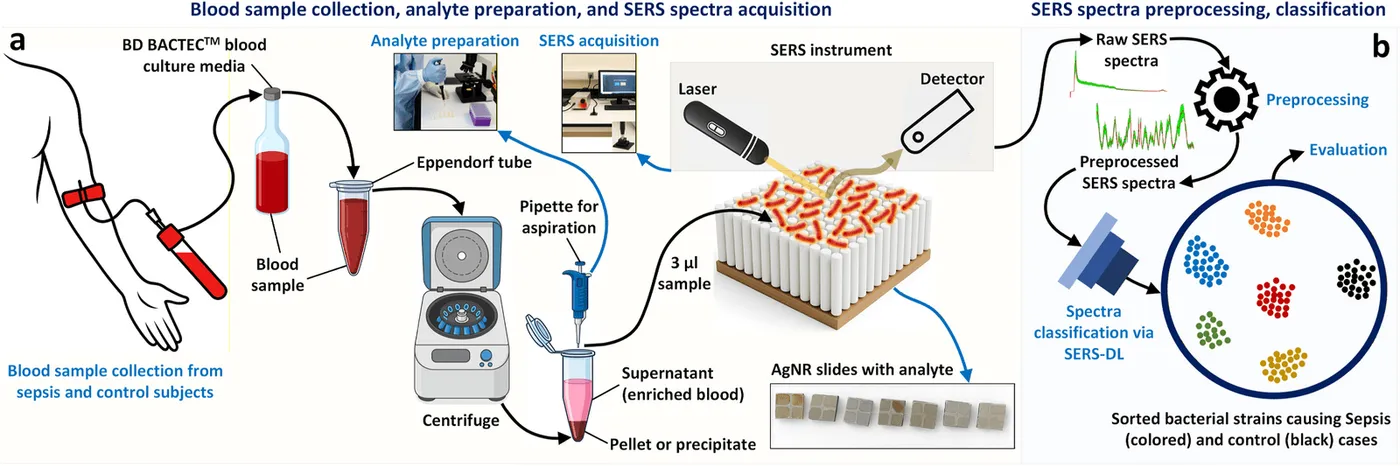
The workflow pairs analyte enrichment and surface-enhanced Raman acquisition with SuperRamanNet, a one-dimensional classifier. The study used 653 blood samples for the primary analysis and an independent external cohort of 70 samples. It evaluated sepsis recognition and pathogen identification as separate tasks.
- Enrich the analyte from blood
- Acquire and preprocess SERS spectra
- Classify with SuperRamanNet
Reported results
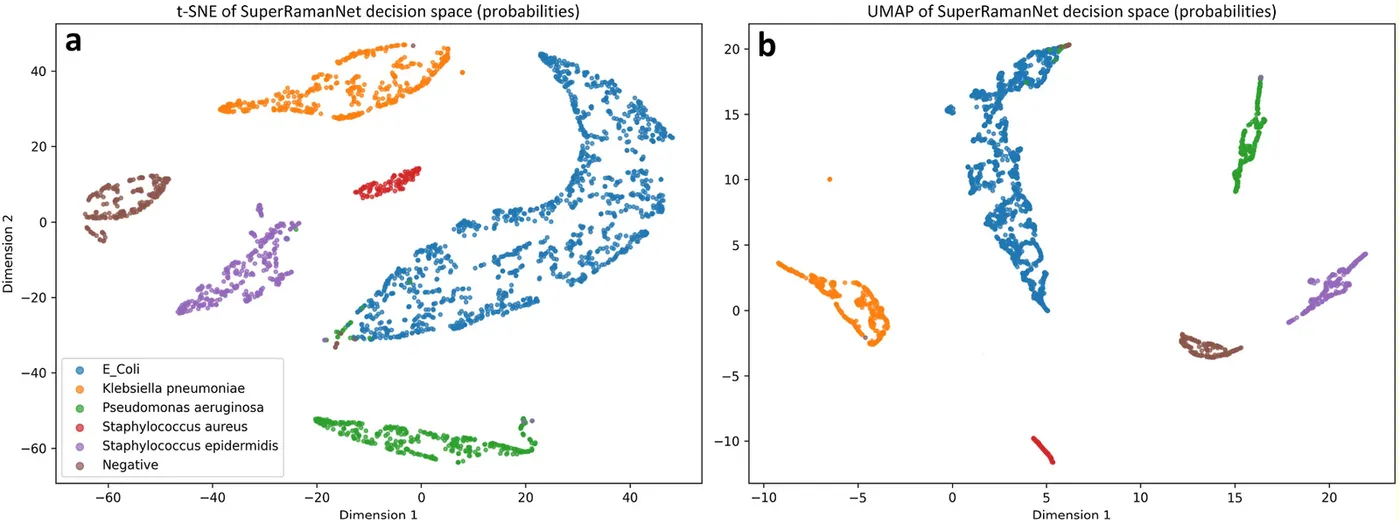
Five-fold validation kept spectra from each blood sample together. Pathogen typing was also evaluated in the external cohort.
- Sepsis recognition accuracy in cross-validation
- 99.67%
- Six-class pathogen accuracy in cross-validation
- 98.84%
- External pathogen typing accuracy
- 98.28%
My contribution
I developed the computational workflow from spectra and preprocessing through data splitting, training, evaluation and interpretation, and helped document the experimental protocol.
Study scope
The evaluation concerns the sample preparation, acquisition, labels and cohorts described in the paper. Clinical deployment would require further validation.