Physiological signal processing · 2024–2025
Cascaded 1D-CycleGANs for improved cardiovascular monitoring from wearable wrist PPG
A two-stage 1D-CycleGAN pipeline that restores noisy wrist PPG, translates it to finger PPG and improves agreement with ECG-derived heart rate and variability.
Qatar National Research Fund NPRP12S-0227-190164 · Prince Sattam Bin Abdulaziz University project PSAU/2023/R/1444
Approach
Can noisy wrist PPG from a wearable be restored and then translated into finger PPG that follows the heart more closely?
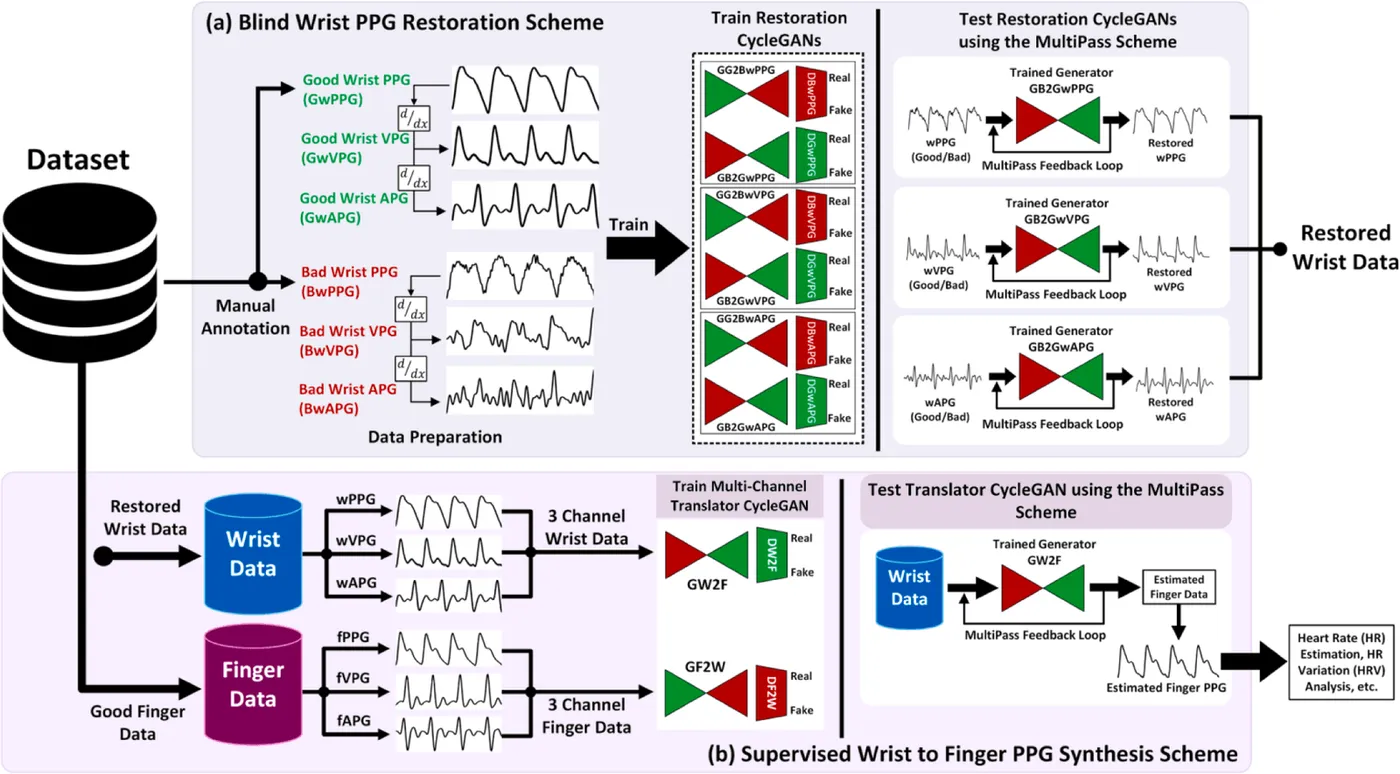
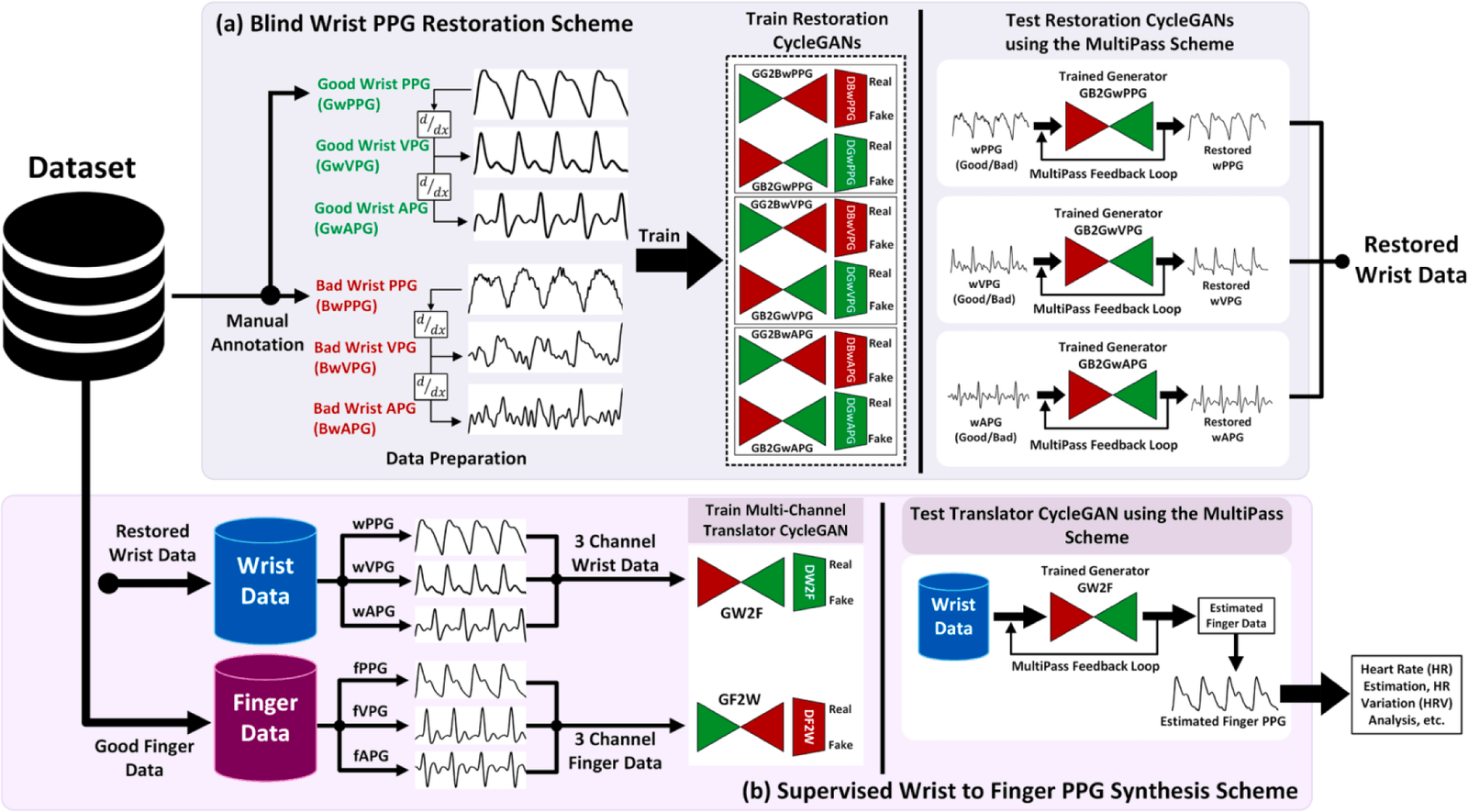
Wrist-worn sensors make long-term pulse monitoring practical, but movement, changing skin contact and noise distort their signals, and wrist PPG carries less detail than clinical finger PPG. Translation Through Restoration GAN (TTR-GAN) handles these as two separate problems. The first 1D-CycleGAN stage removes artefacts from the wrist signal. The second converts the restored signal into finger PPG. Heart rate and variability from ECG then provide an independent check.
- Restore wrist PPG
- Translate to finger PPG
- Validate against ECG
Stage 1: blind restoration of wrist PPG
Unpaired 1D-CycleGANs
The study used MAUS, with about 12 hours 50 minutes of recordings from 22 healthy young adults. A wristwatch recorded wrist PPG while finger PPG and ECG were captured at the same time. Signals were resampled to 125 Hz and split into 512-sample segments. Wrist segments were sorted by hand into 1,876 good, 2,732 mediocre and 4,204 bad, and 164 unusable segments were removed.
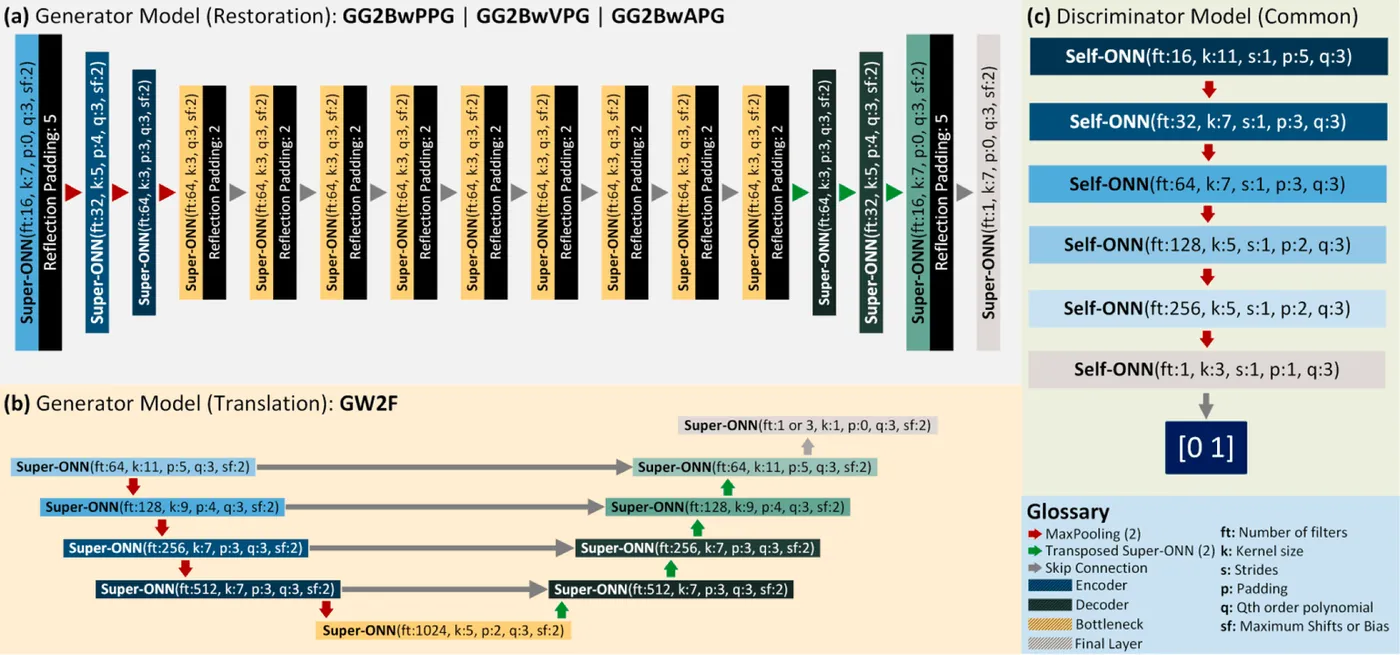
A corrupted wrist signal has no clean recording of the same moment, so the CycleGANs learned from unpaired good and bad examples, without being told the type of artefact. Separate restorers handled wrist PPG and its first and second derivatives (VPG and APG). Each generator was a nine-block residual network built from Super-ONN layers and tested with five-fold cross-validation on separate people.
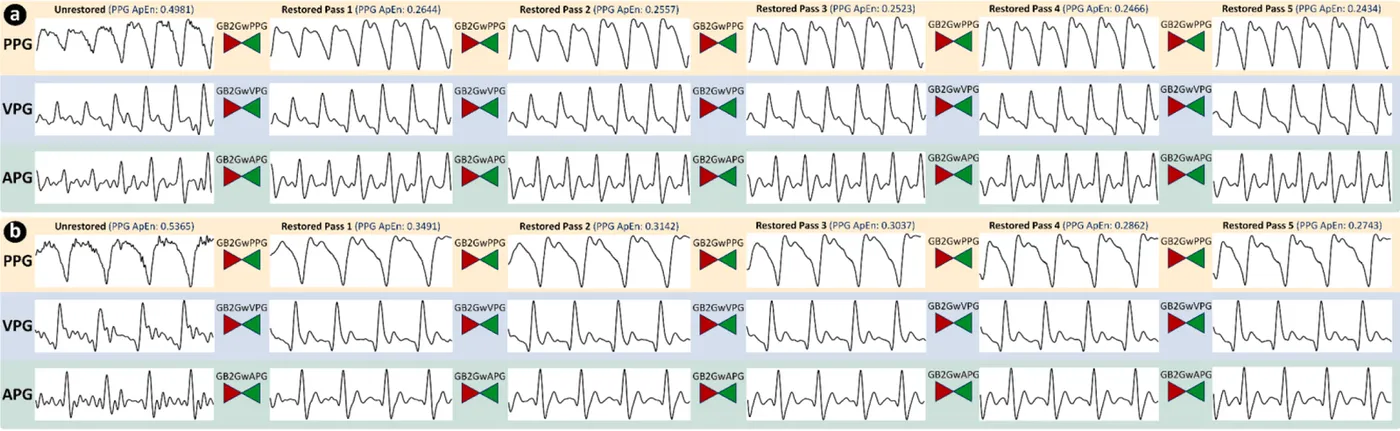
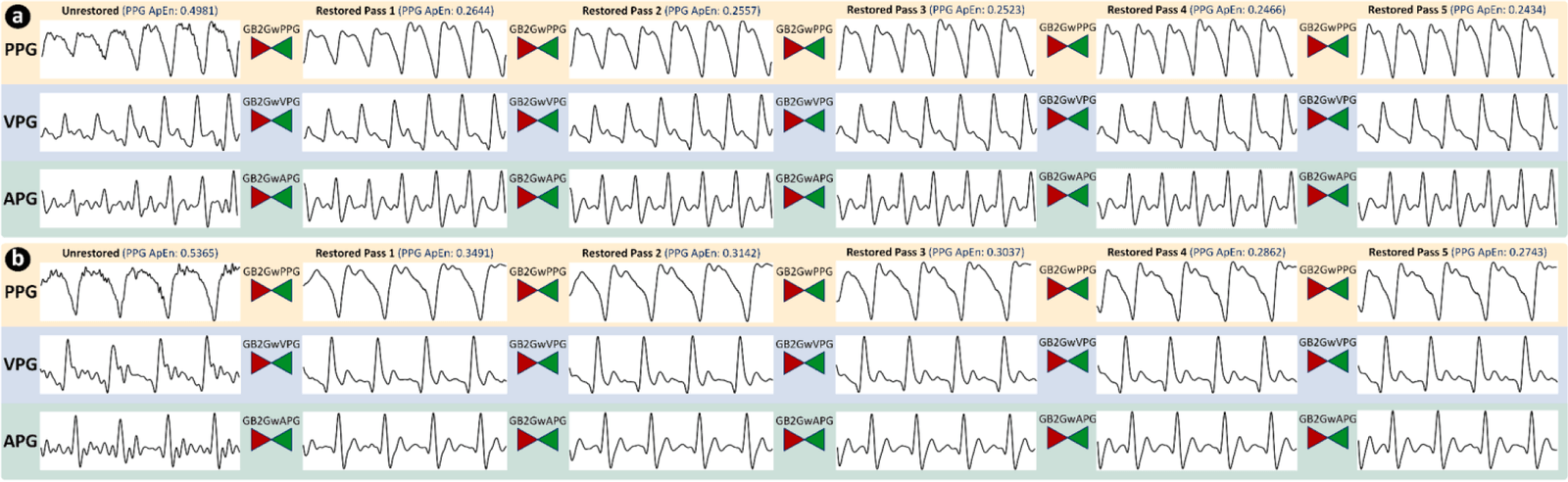
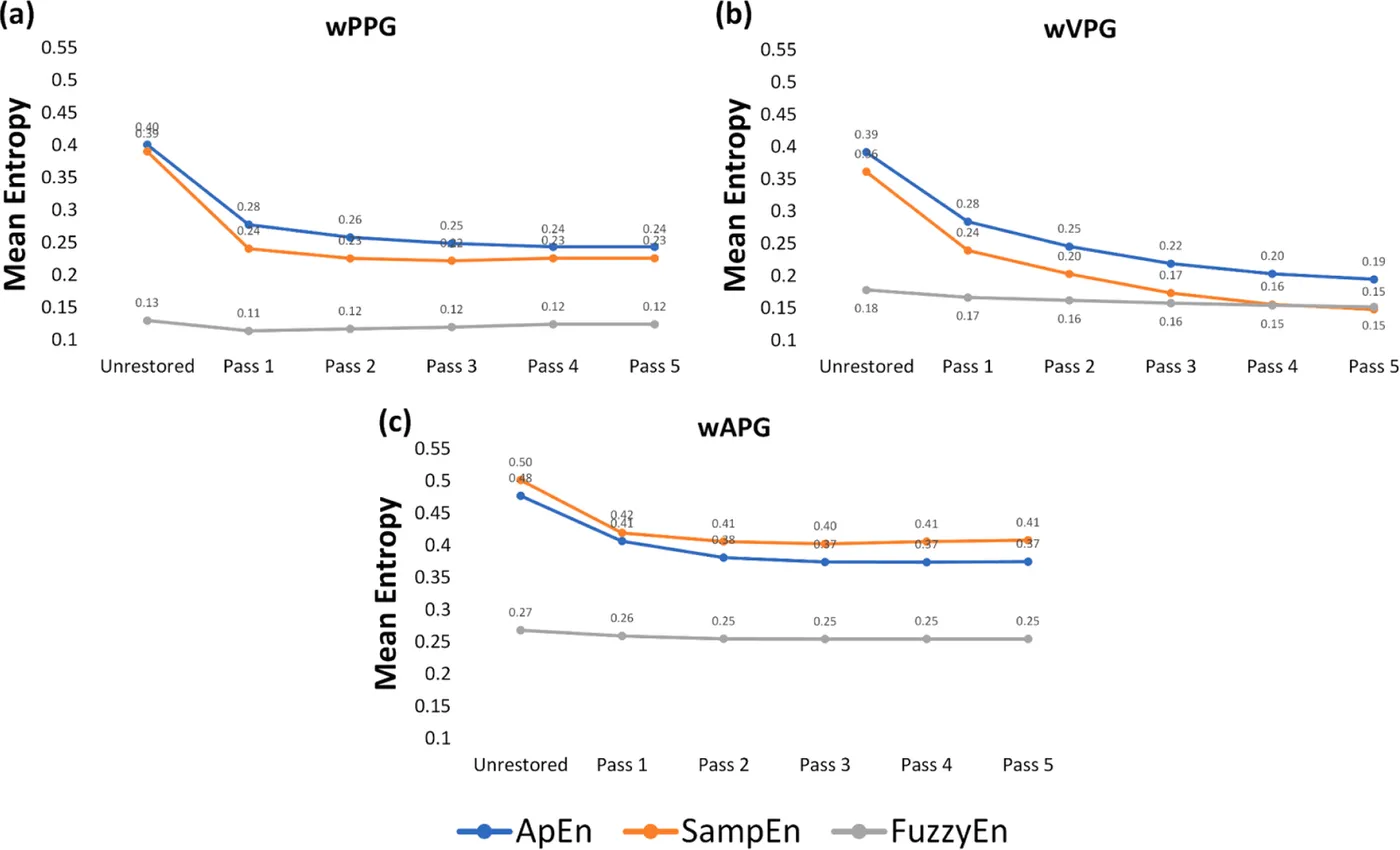
With no clean target to compare against, restoration was measured by the fall in signal entropy, a measure of irregularity. Outputs were passed through the generator up to five times. In most cases performance peaked around the third pass, so third-pass signals moved on to translation. Good-quality signals stayed almost unchanged.
- Wrist PPG approximate entropy after three passes
- 0.40 → 0.25
- Wrist PPG sample entropy after three passes
- 0.39 → 0.22
- Restoration passes selected for translation
- 3
| Approximate entropy | Sample entropy | Fuzzy entropy | |
|---|---|---|---|
| Wrist PPG | 0.40 → 0.25 | 0.39 → 0.22 | 0.13 → 0.12 |
| First derivative (VPG) | 0.39 → 0.22 | 0.36 → 0.17 | 0.18 → 0.16 |
| Second derivative (APG) | 0.48 → 0.37 | 0.50 → 0.40 | 0.27 → 0.25 |
Stage 2: translating restored wrist PPG to finger PPG
Three-channel 1D-CycleGAN
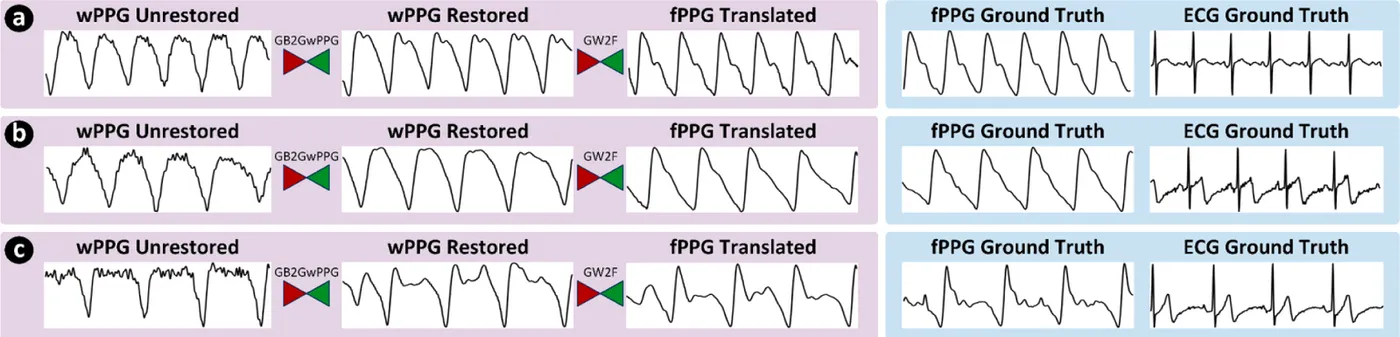
Even a clean wrist signal differs from finger PPG in shape and timing, and it carries less of the detail used in clinical analysis. The second CycleGAN therefore learned from 8,812 time-matched pairs of restored wrist and reference finger segments. Its Super-ONN UNet generator received restored wrist PPG, VPG and APG as three input channels.
Ordinary correlation penalised the natural time shift between wrist and finger, so the study introduced PRTX, which combines temporal cross-correlation with signal power ratio. Translation raised PRTX from 0.5867 to 0.9455 against the reference finger PPG. Restoring the wrist signal first gave a better result than translating it directly, and using all three channels added a further gain.
- PRTX of translated finger PPG
- 0.9455
- PRTX gain over restored wrist PPG
- +35.88 points
| Single channel | Three channels | |
|---|---|---|
| Restored wrist PPG, before translation | 0.5867 | 0.5867 |
| Translated without restoration | 0.8953 | 0.9212 |
| Translated after restoration | 0.9357 | 0.9455 |
Checking pulse rate and variability against ECG
Evaluation of the full pipeline
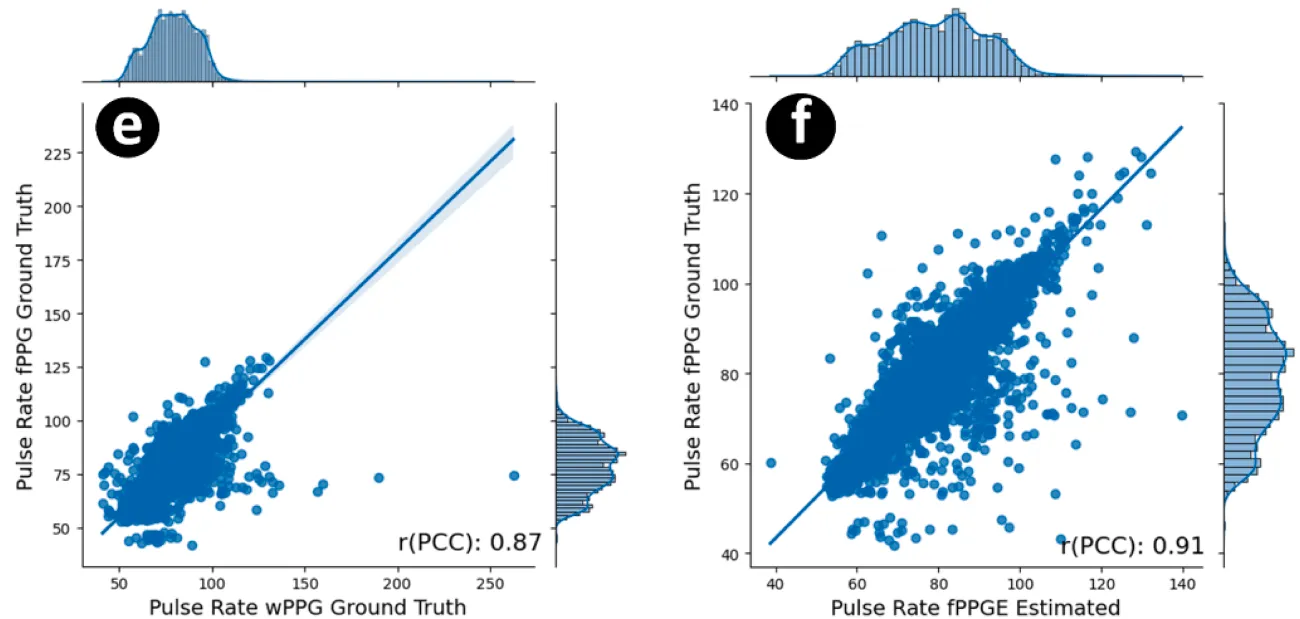
ECG was not used for training. It served only as an independent reference for heart rate and heart rate variability (SDNN). Each stage improved agreement with ECG: restoration gave a first gain and translation a larger one. Measured finger PPG remained the closest match, so the translated signal narrows the gap without replacing a finger sensor.
- Pulse rate correlation with ECG heart rate
- 0.797 → 0.900
- Pulse rate variability correlation with ECG
- 0.699 → 0.846
| Rate | Variability (SDNN) | |
|---|---|---|
| Raw wrist PPG | 0.7968 | 0.6991 |
| Restored wrist PPG | 0.8304 | 0.7438 |
| Translated finger PPG | 0.9003 | 0.8457 |
| Measured finger PPG | 0.9242 | 0.9254 |
Comparing CNN, Self-ONN and Super-ONN generators
Performance and computational cost
The same restoration and translation pipeline was built with three neuron types. Super-ONN gave the largest gains but also needed the most parameters and the longest inference time, so a wearable design would have to weigh accuracy against cost.
| PRTX gain | Rate gain | Variability gain | Restorer | Translator | |
|---|---|---|---|---|---|
| CNN | 32.8 | 9.6 | 12.6 | 0.240 M · 12.9 ms | 0.853 M · 6.61 ms |
| Self-ONN | 33.7 | 9.8 | 12.9 | 0.715 M · 18.2 ms | 2.176 M · 15.7 ms |
| Super-ONN | 35.9 | 10.4 | 14.7 | 1.048 M · 26.7 ms | 2.184 M · 23.0 ms |
Follow-on study: atrial fibrillation detection
Biomedical Signal Processing and Control · 2025
The atrial fibrillation study applied 1D-CycleGAN restoration to wrist PPG before classifying atrial fibrillation. Restoration raised classification accuracy by 2.94 and 5.08 percentage points in two test splits, and the Self-AFNet classifier reached 96.41% and 97.09%. This study used restoration without the finger PPG translation stage.
My contribution
I led the development and evaluation of TTR-GAN, including the Super-ONN-based 1D-CycleGAN methodology, the experiments, the quantitative and qualitative analysis and the manuscript. For the atrial fibrillation study, I developed the 1D-CycleGAN implementation used for wrist PPG restoration and contributed to conceptualisation, formal analysis and writing.
Study scope
TTR-GAN was developed on one dataset of 22 healthy young adults and was not tested on an independent cohort. Restoration was judged by entropy because no clean reference exists for a corrupted wrist segment. Rare arrhythmic segments from one participant were harder to reproduce, and on-device performance was not reported. Patient data and testing on wearable hardware are the next requirements.
Publications
- Wearable wrist to finger photoplethysmogram translation through restoration using super operational neural networks based 1D-CycleGAN for enhancing cardiovascular monitoringExpert Systems with Applications · 2024
- A novel 1D generative adversarial network-based framework for atrial fibrillation detection using restored wrist photoplethysmography signalsBiomedical Signal Processing and Control · 2025