Physiological signal processing · 2022
QUCoughScope: COVID-19 screening from cough and breath sounds
A web and mobile application that records cough and breath sounds and screens for COVID-19 with stacked deep learning models, for people with and without symptoms.
Qatar University · Qatar National Research Fund UREP28-144-3-046
Approach
Can cough and breath recordings made at home screen for COVID-19 in people with and without symptoms?
Many people with COVID-19 have no symptoms and are unlikely to be tested, so they can spread the virus without knowing it, while RT-PCR testing is invasive and depends on clinical resources. Earlier studies suggested that infection changes how people cough and breathe. QUCoughScope combined a public cough and breath dataset with recordings crowdsourced through its own application, trained stacked deep learning models on sound spectrograms, and deployed the best models behind an application that returns a screening result to the user.
- Collect cough and breath recordings
- Classify sound spectrograms
- Return a screening result in the app
Combining public and crowdsourced recordings
Diagnostics · 2022
The University of Cambridge COVID-19 Sounds dataset, shared on request, provided cough and breath recordings from 582 healthy people and 141 people with COVID-19. The team added recordings collected anonymously through the QUCoughScope application from 245 healthy people and 96 with COVID-19.
Participants reported their symptoms, so each group was divided into people with a cough and people without symptoms. This gave four experiments: cough or breath sounds, for people with or without symptoms.
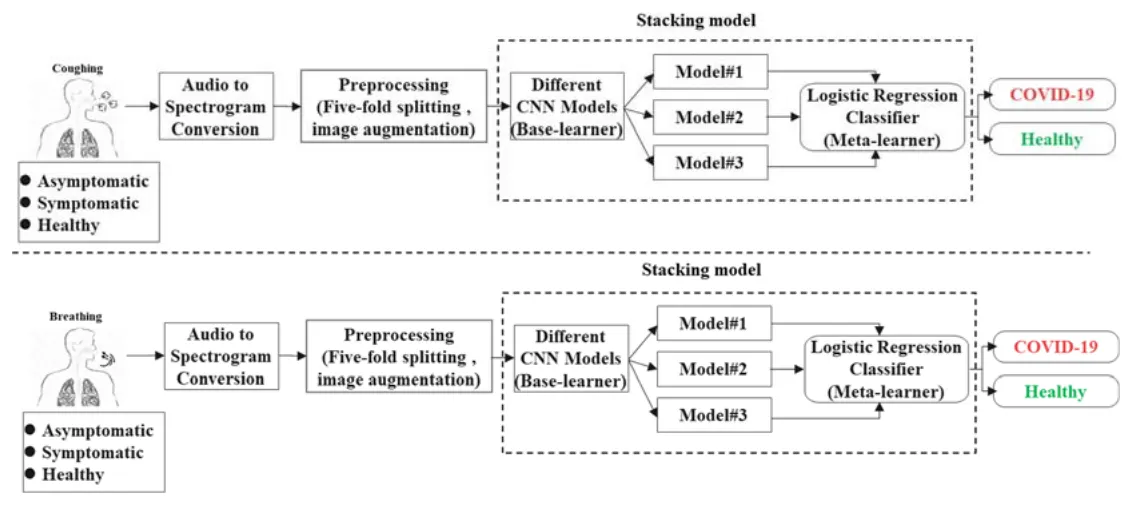
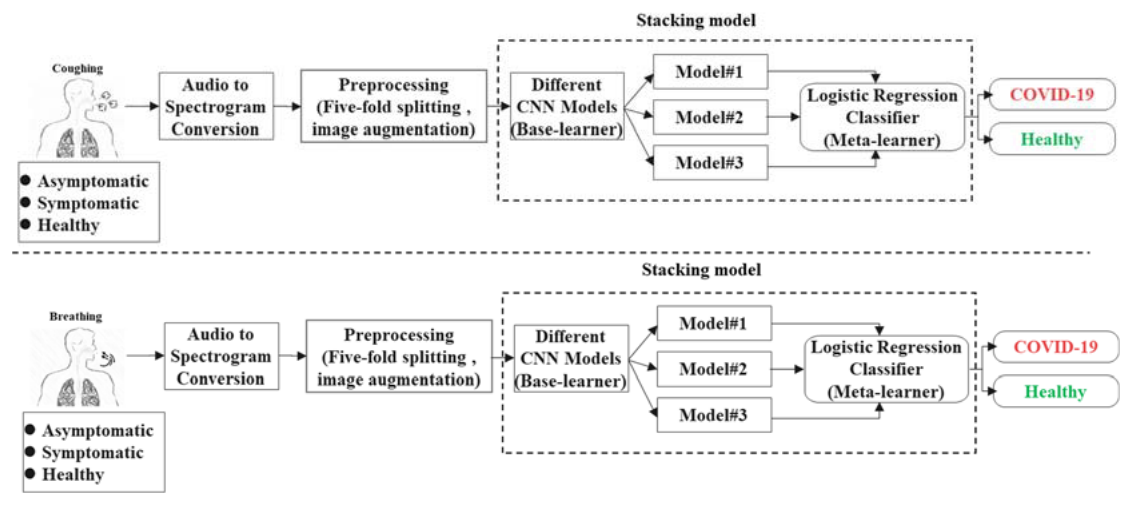
Each recording was converted into a spectrogram with the short-time Fourier transform. The spectrogram images were augmented and evaluated with five-fold cross-validation, using 80% for training and 20% for testing in each fold.
- Participants across both datasets
- 1,064
- People with COVID-19
- 237
- Experiments by sound and symptom group
- 4
| Healthy, with cough | Healthy, no symptoms | COVID-19, with cough | COVID-19, no symptoms | |
|---|---|---|---|---|
| University of Cambridge | 264 | 318 | 54 | 87 |
| QUCoughScope application | 32 | 213 | 18 | 78 |
Stacking CNNs on sound spectrograms
Model development
Eight pretrained CNNs, including ResNet, DenseNet201, Inception-v3, MobileNetV2 and EfficientNet-B0 and B7, were trained on the spectrograms. For each experiment the three best became base learners, and a logistic regression meta-learner combined their predictions.
The stacked model outperformed every single CNN. Cough sounds separated people with COVID-19 from healthy people more reliably than breath sounds: accuracy reached 96.5% for people with symptoms and 98.85% for those without, compared with 91.03% and 80.01% from breath.
- Accuracy from cough, no symptoms
- 98.85%
- Accuracy from cough, with symptoms
- 96.5%
- CNNs compared as base learners
- 8
| Accuracy | Sensitivity | Specificity | |
|---|---|---|---|
| Cough, with symptoms | 96.5 | 96.42 | 95.47 |
| Cough, no symptoms | 98.85 | 97.01 | 99.6 |
| Breath, with symptoms | 91.03 | 88.9 | 91.5 |
| Breath, no symptoms | 80.01 | 72.04 | 82.67 |
Screening through a web and mobile application
Deployed prototype
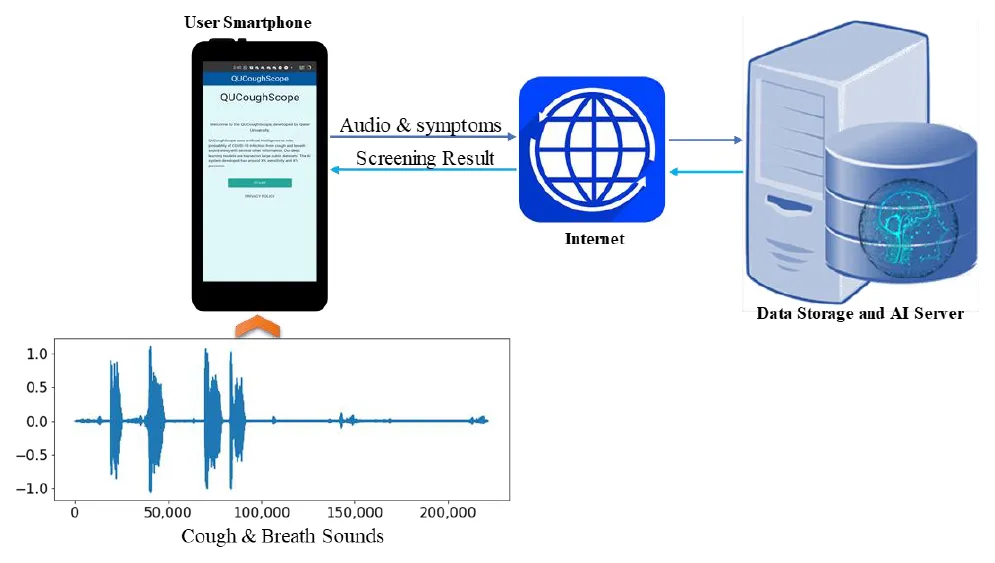
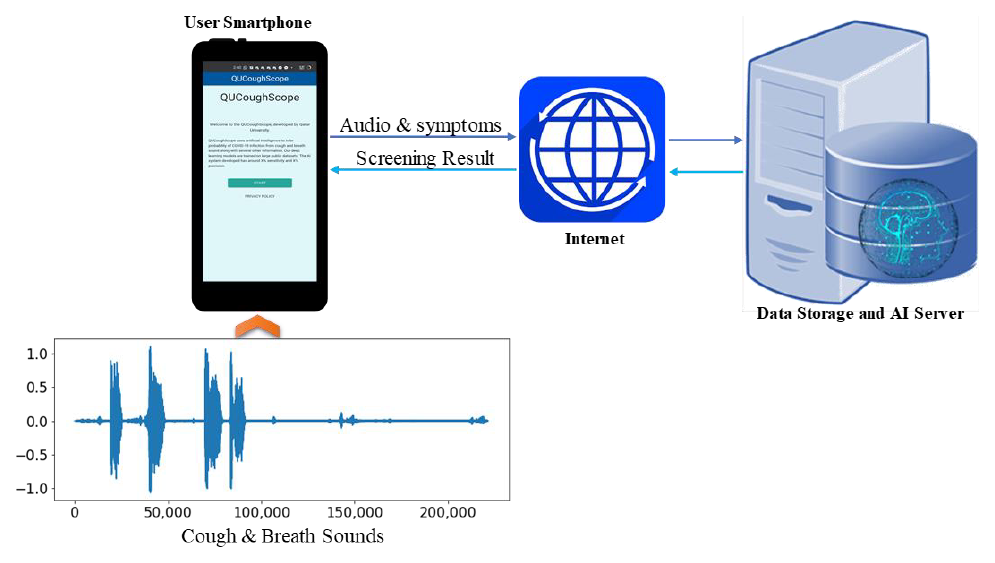
The application, built with Flutter for the web, Android and iOS, asks for basic demographic details and symptoms, then records cough and breath sounds through the device microphone. Recordings are sent over HTTPS to a backend running on Google cloud computing, converted into spectrograms and classified by the pipeline that matches the reported symptoms.
The screening result is returned to the user and stored in a cloud database. The same application collected the new recordings used in the study. As a next step, the team planned a check so that only cough and breath sounds would be accepted.
My contribution
I contributed to the investigation and methodology, including the technical analysis and validation of the audio classification pipeline, and to drafting the manuscript.
Study scope
Recordings came from volunteers who chose to take part, and COVID-19 status and symptoms were reported by participants. The crowdsourced group with symptoms was small, and performance was measured with five-fold cross-validation rather than on a separate prospective cohort. The application is intended as pre-screening to prioritise testing, not as a diagnostic test.