Physiological signal processing · 2022
Respiration rate estimation from PPG
A lightweight ConvMixer network that estimates breathing rate directly from photoplethysmogram signals, tested within and across public datasets.
Qatar University and Universiti Kebangsaan Malaysia · Qatar National Research Fund NPRP12S-0227-190164
Approach
Can a compact deep learning model estimate respiration rate directly from PPG accurately enough for continuous monitoring?
Respiration rate is a key vital sign, but outside intensive care it is often counted by hand. PPG sensors in pulse oximeters and wearables already capture breathing-related changes in the pulse. This study estimated respiration rate end to end from short PPG windows, without hand-crafted features, and examined how well a model trained on one population transfers to another.
- Clean and segment PPG
- Estimate respiration rate with ConvMixer
- Test across datasets
Estimating respiration rate end to end
Bioengineering · 2022
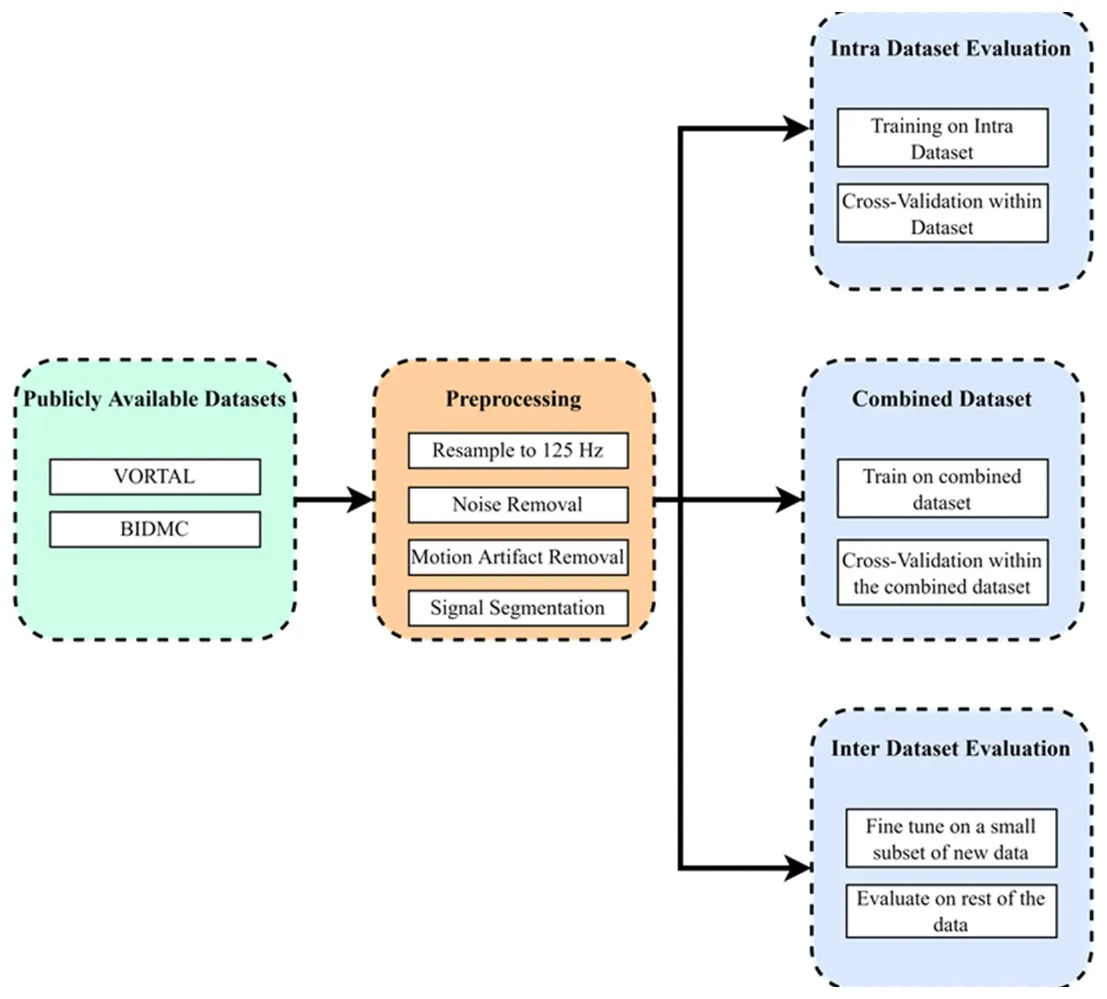
Two public datasets provided PPG with reference respiration rate: VORTAL, with 39 healthy volunteers at rest, and BIDMC, with 53 intensive care patients. Signals were resampled to 125 Hz, low-pass filtered, cleaned of motion artefacts with variational mode decomposition and cut into 16-second windows with 50% overlap.
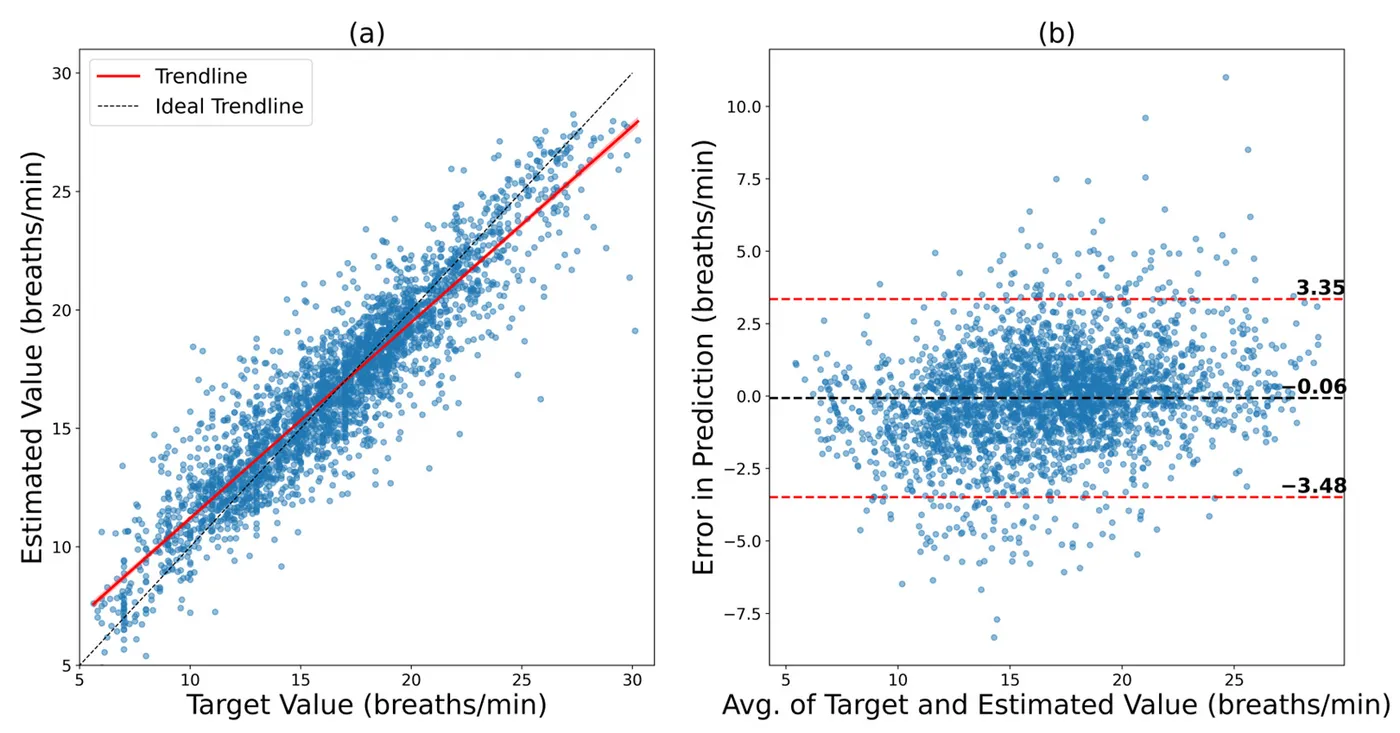
Five 1D networks were compared with five-fold cross-validation: ResNet18, Inception-v1, MobileNet-v1, DenseNet121 and ConvMixer. ConvMixer, which mixes signal patches with depthwise and pointwise convolutions, was clearly the most accurate, with a mean absolute error of 1.27 breaths per minute on VORTAL and 0.77 on BIDMC.
- Mean absolute error on VORTAL (breaths/min)
- 1.27
- Mean absolute error on BIDMC (breaths/min)
- 0.77
- Correlation with the reference on both datasets
- 0.92
| Correlation (R) | MAE (breaths/min) | RMSE (breaths/min) | |
|---|---|---|---|
| ResNet18 | 0.646 | 2.69 | 3.43 |
| Inception-v1 | 0.824 | 1.87 | 2.55 |
| MobileNet-v1 | 0.735 | 2.43 | 3.17 |
| DenseNet121 | 0.749 | 2.23 | 2.98 |
| ConvMixer | 0.921 | 1.27 | 1.75 |
Transferring to a new population
Cross-dataset evaluation
A model trained on one dataset did poorly on the other. Root mean square error rose to 4.98 breaths per minute from BIDMC to VORTAL and 5.78 in the other direction, reflecting the gap between healthy volunteers and intensive care patients. Training on both datasets together restored a correlation of 0.92.
Fine-tuning on only 10% of the new dataset, with another 10% for validation, cut the error to 2.66 and 1.74 breaths per minute, with correlations of 0.80 and 0.81.
- Of the new dataset used for fine-tuning
- 10%
- Error after fine-tuning, BIDMC to VORTAL (breaths/min)
- 4.98 → 2.66
- Error after fine-tuning, VORTAL to BIDMC (breaths/min)
- 5.78 → 1.74
| Correlation (R) | RMSE (breaths/min) | MAE (breaths/min) | |
|---|---|---|---|
| Five-fold, VORTAL | 0.921 | 1.75 | 1.27 |
| Five-fold, BIDMC | 0.916 | 1.20 | 0.77 |
| Five-fold, both datasets | 0.918 | 1.52 | 1.04 |
| BIDMC model fine-tuned on VORTAL | 0.802 | 2.66 | 2.02 |
| VORTAL model fine-tuned on BIDMC | 0.812 | 1.74 | 1.18 |
My contribution
I contributed to data curation, formal analysis and methodology, and to drafting the manuscript.
Study scope
Both datasets were recorded at rest with clinical or laboratory PPG rather than wearable devices in daily life. Results within each dataset come from five-fold cross-validation, and testing during movement and on wearable hardware would be needed before continuous monitoring.