Applied machine learning · 2024
Lightweight deep learning for early gearbox fault detection
GearFaultNet, a compact one-dimensional network that flags a broken gear from four-channel vibration signals, tested on loading conditions it had not seen in training.
Qatar University and Kennesaw State University


Approach
Can a small one-dimensional network detect a broken gear from vibration signals reliably enough for real-time monitoring, even under loads it was not trained on?
Gearboxes transmit power in wind and hydro turbines, generators and pumps, and in wind turbines they cause more downtime than any other component. Faults found late lead to unplanned shutdowns and costly repairs. Many detection methods rely on heavy preprocessing or large models that are hard to run in real time. This study built GearFaultNet, a shallow one-dimensional convolutional network that labels short windows of vibration as healthy or broken after simple normalisation.
- Segment and normalise vibration signals
- Classify each window with GearFaultNet
- Test on unseen loading conditions
Preparing four-channel vibration data
IEEE Access · 2024
The study used the public Gear Box Fault Diagnosis dataset, recorded on SpectraQuest’s gearbox fault simulator. Four accelerometers on the gearbox body measured vibration for a healthy gear and a broken gear under ten loading conditions, from 0% to 90% in steps of 10%.
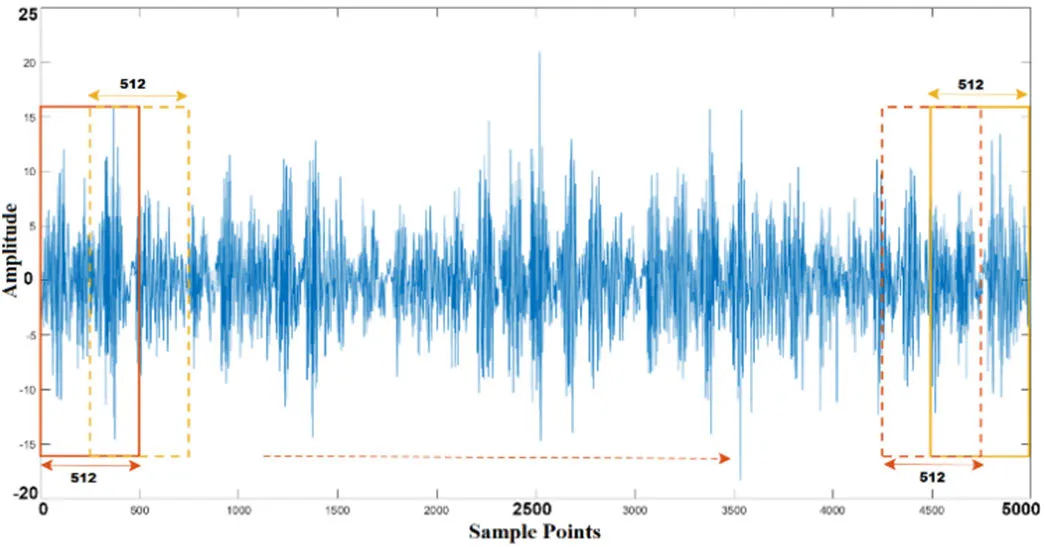
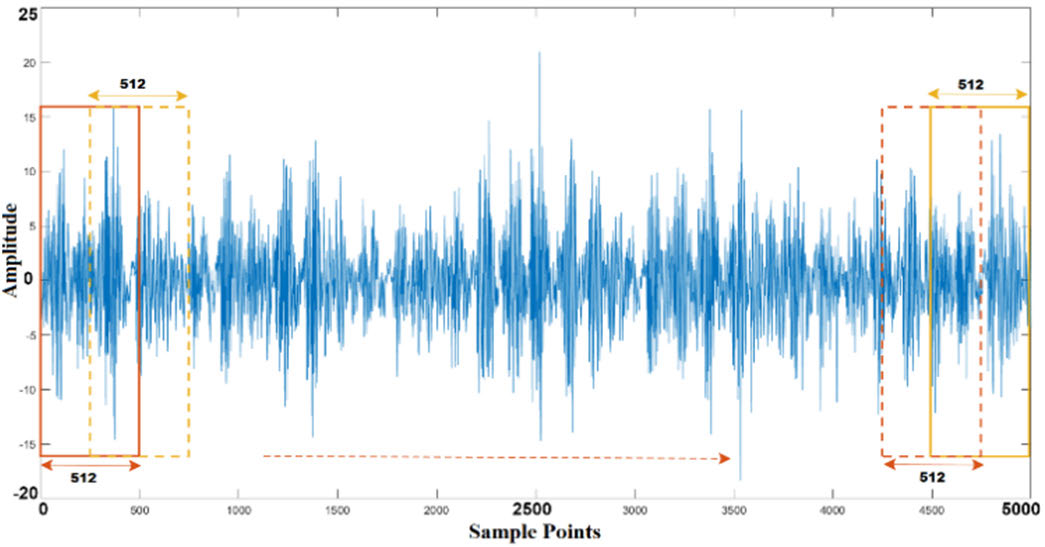
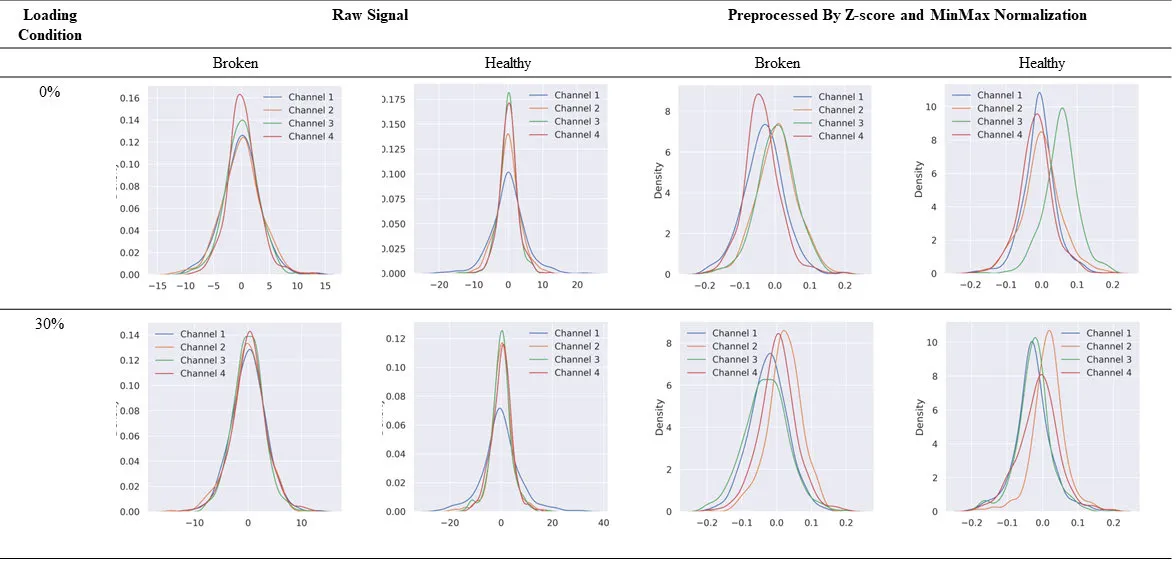
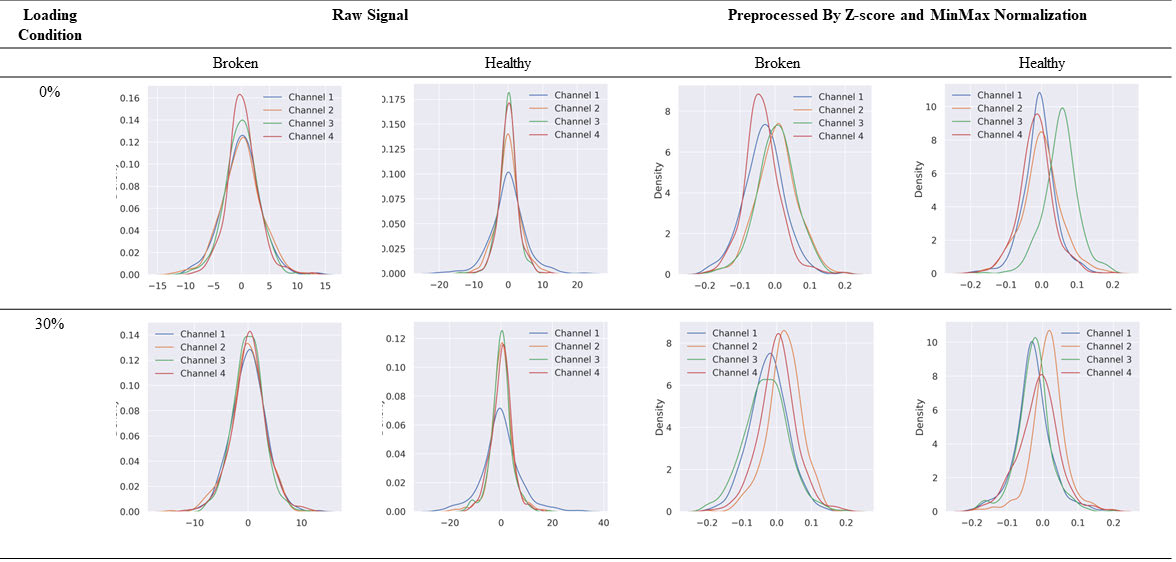
Each channel was cut into windows of 512 samples. Training windows overlapped by half to give the network more examples. Each channel was then standardised to zero mean and unit variance and scaled to a range of −0.2 to 0.2, simple steps that keep preprocessing fast.
The folds were split by load. Each of the ten folds held out one loading condition for testing and trained on the others, so the model was always tested on a load it had not seen. This also avoids the overlap between training and test data that shuffling windows before splitting can create.
- Accelerometer channels
- 4
- Samples per window
- 512
- Loading conditions, one per test fold
- 10
Designing a lightweight one-dimensional classifier
Model design
GearFaultNet takes each four-channel window as a 4 × 512 input. Five small blocks of 1D convolution, batch normalisation and tanh activation extract features, with 16 to 32 filters per block. Max pooling in the first block halves the length, and adaptive average pooling reduces the final features to 16 × 8 before a small dense classifier labels the window as healthy or broken.
The loss passed the outputs through a softmax and then a mean squared error. Training used the Adam optimiser on Google Colab, and the learning rate was lowered and training stopped early when validation loss stopped improving.
- Convolutional blocks
- 5
- Input per window
- 4 × 512
- Features passed to the classifier
- 16 × 8
| Value | |
|---|---|
| Batch size | 4 |
| Maximum epochs | 200 |
| Learning rate | 0.0002, reduced by a factor of 0.2 after 10 epochs without improvement |
| Early stopping | After 30 epochs without improvement |
| Optimiser | Adam |
| Loss function | Softmax followed by mean squared error |
Detecting broken gears under unseen loads
Ten-fold evaluation
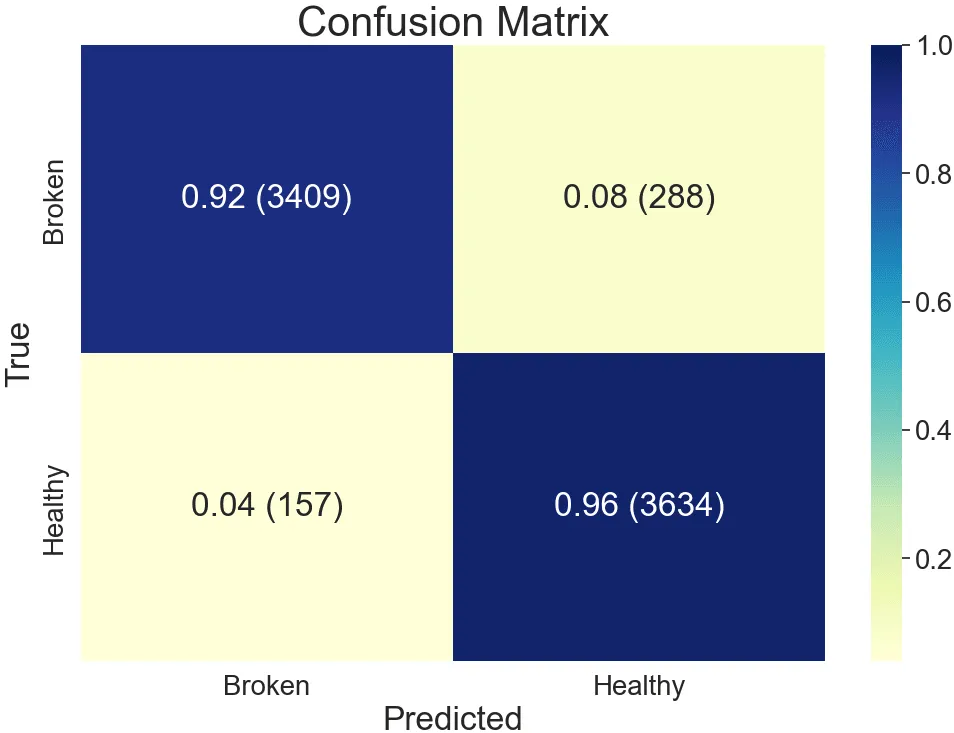
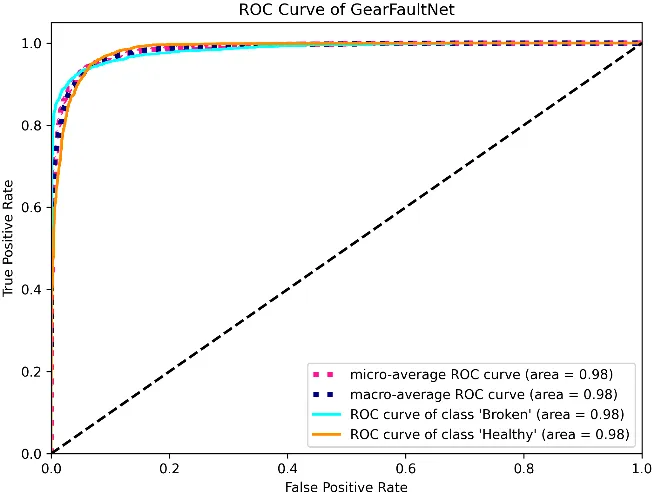
Across the ten folds there were 7,488 test windows: 3,697 from the broken gear and 3,791 from the healthy one. GearFaultNet classified 94.06% correctly. It found 3,409 broken-gear windows and missed 288, and it raised 157 false alarms among the healthy windows. Precision was higher for the broken class, at 95.60%, while recall was higher for the healthy class, at 95.86%. Both classes had an area under the ROC curve of 0.98.
Under the same settings, GearFaultNet outperformed a 1D ResNet18 (77.74% accuracy) and Self-ResNet18, a version built with self-organised operational layers (92.74%). Earlier hybrid LSTM methods on the same dataset reported 87.50%. Studies that reported 100% shuffled windows before splitting, whereas the load-based split here keeps each test load out of training.
- Accuracy
- 94.06%
- Area under the ROC curve
- 0.98
- Test windows across ten folds
- 7,488
| Accuracy | Precision | Sensitivity | Specificity | F1 score | |
|---|---|---|---|---|---|
| ResNet18 | 77.74 | 78.10 | 77.74 | 77.58 | 77.64 |
| Self-ResNet18 | 92.74 | 93.20 | 92.74 | 92.60 | 92.71 |
| GearFaultNet | 94.06 | 94.11 | 94.06 | 94.01 | 94.05 |
My contribution
I contributed to model evaluation, quantitative analysis, interpretation and manuscript review.
Study scope
The study used one public test-rig dataset with a single fault, a broken gear, compared with healthy operation. Other fault types, gearboxes and sensor layouts were not tested, and the model recognised healthy windows more reliably than broken ones.