Physiological signal processing · 2022–2024
Deep learning restoration of motion-corrupted EEG
Deep learning methods that remove motion artefacts from single-channel EEG while preserving the signal in time and frequency.
Qatar National Research Fund NPRP12S-0227-190164 · Qatar University IRCC-2021-001
Approach
Can clean EEG be recovered from a single channel corrupted by electrode motion?
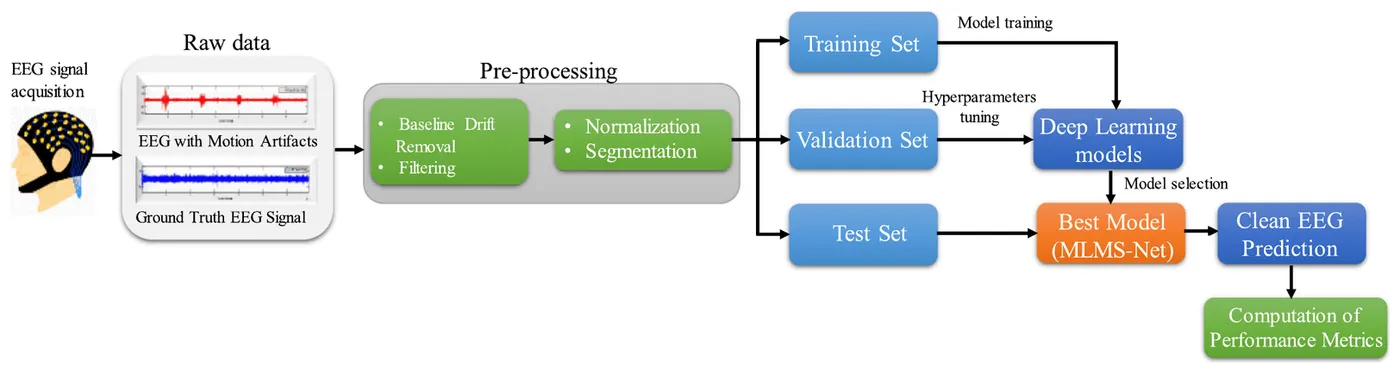
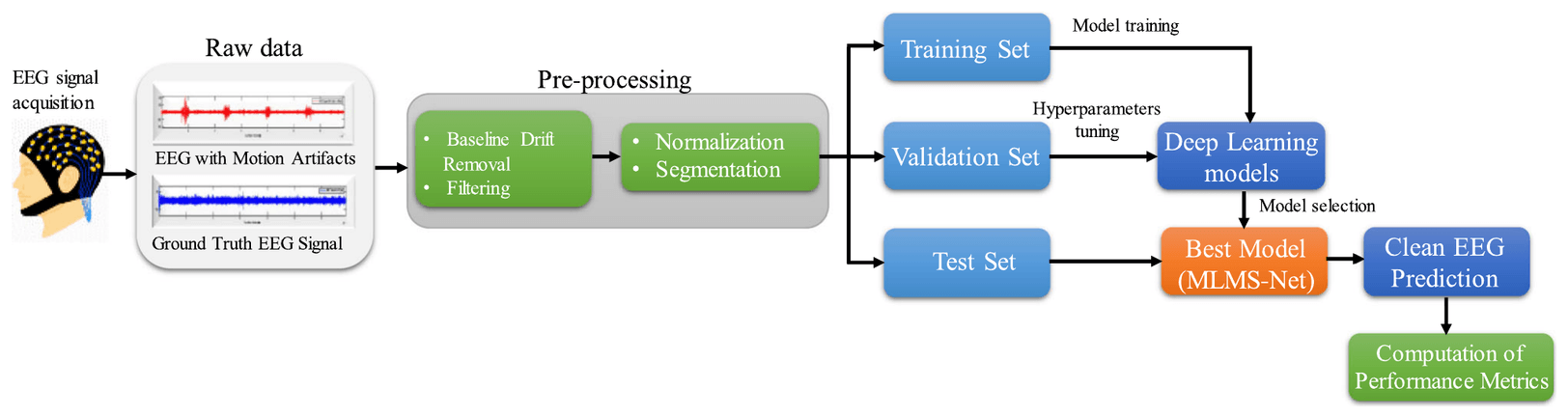
Head and electrode movement can add artefacts far stronger than the EEG itself, which limits recording outside controlled settings. This project first developed MLMRS-Net, a multi-resolution network for reconstructing clean EEG. It then developed AGO-CycleGAN, an attention-guided operational CycleGAN that restores corrupted EEG and recovers its frequency content.
- Record motion-corrupted EEG
- Restore the EEG waveform
- Evaluate time and frequency recovery
Removing motion artefacts with MLMRS-Net
Neural Computing and Applications · 2023
The study used a public PhysioNet dataset of 23 single-channel prefrontal EEG recordings. In each 9-minute recording, two electrodes sat 30 mm apart. One stayed undisturbed as the reference, and the other was tapped for 10 to 25 seconds about every two minutes. Signals were resampled to 256 Hz, baseline-corrected, notch-filtered at 50 Hz and split into 1,024-sample segments.
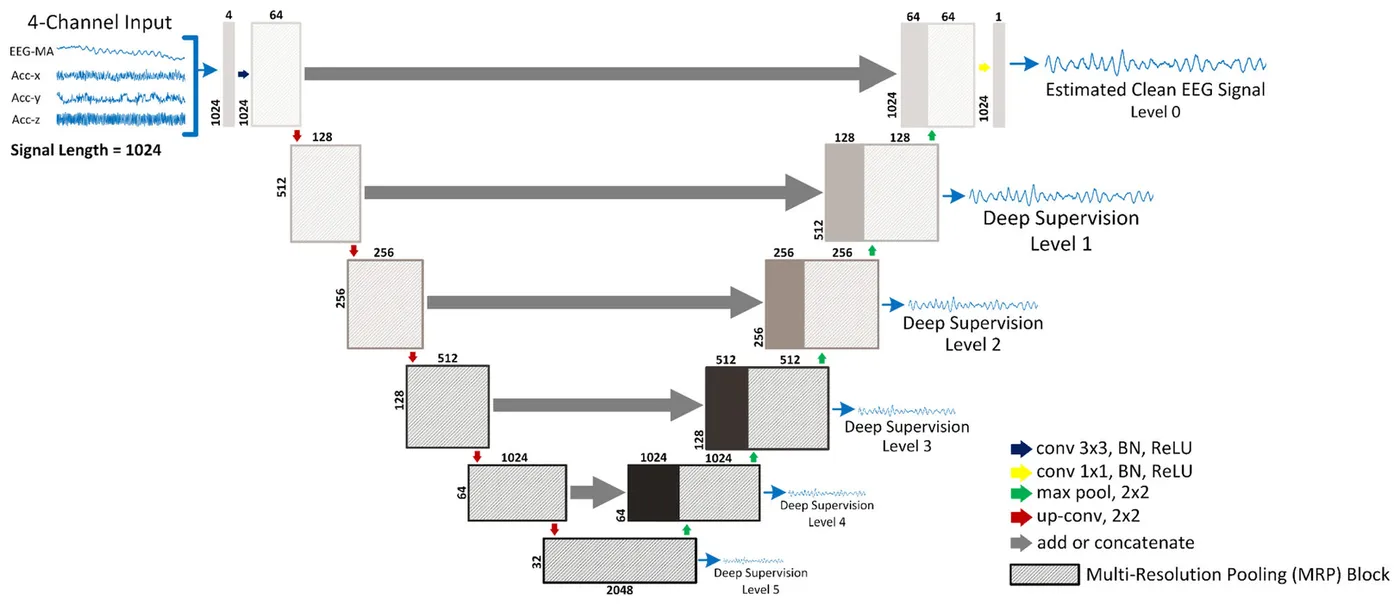
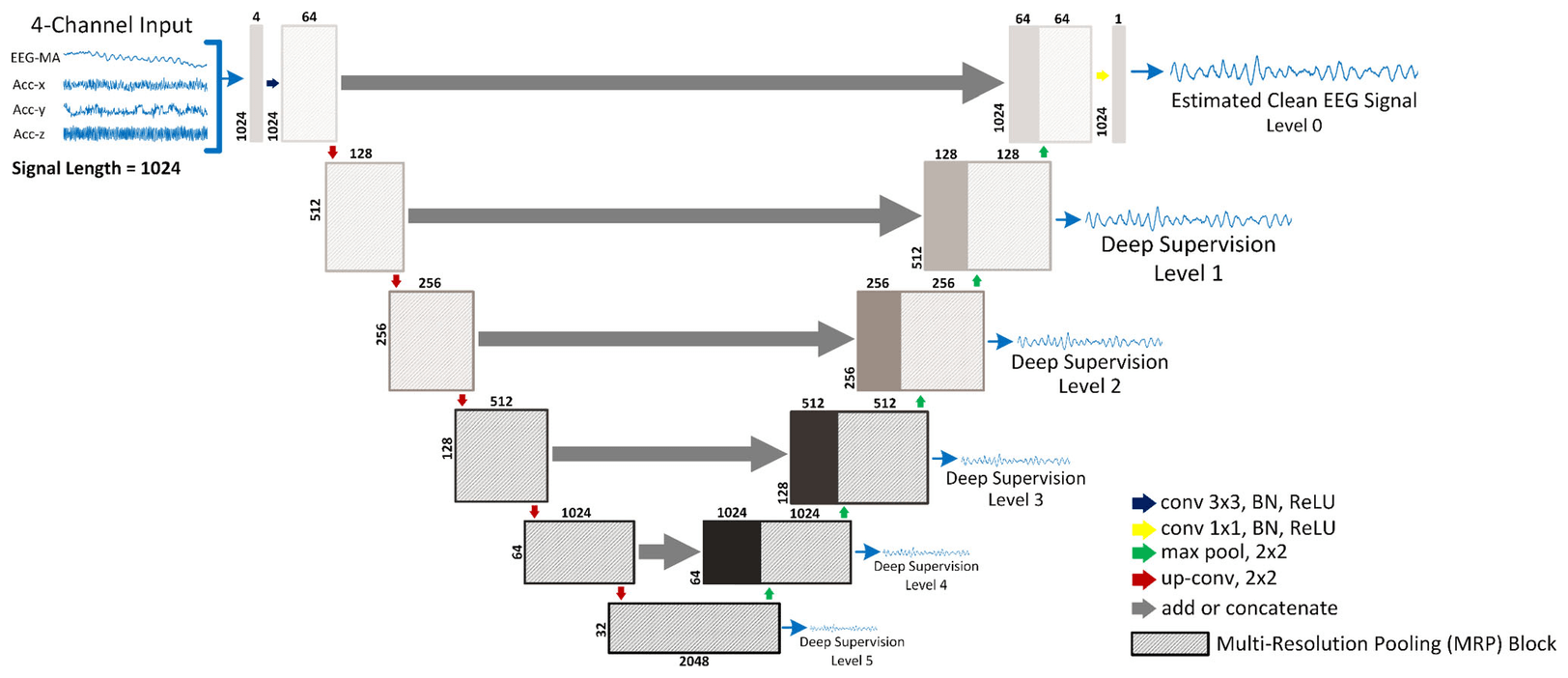
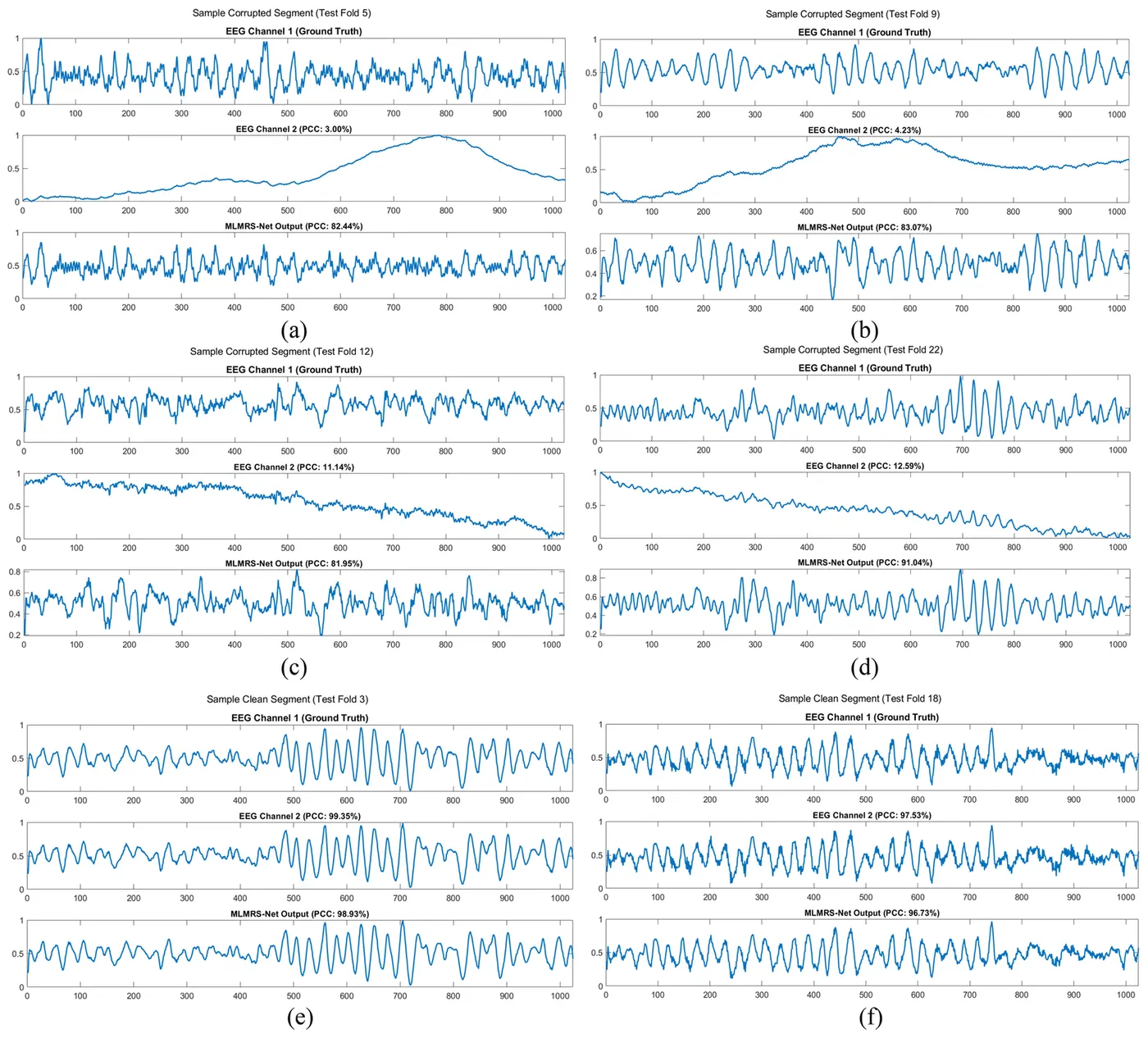
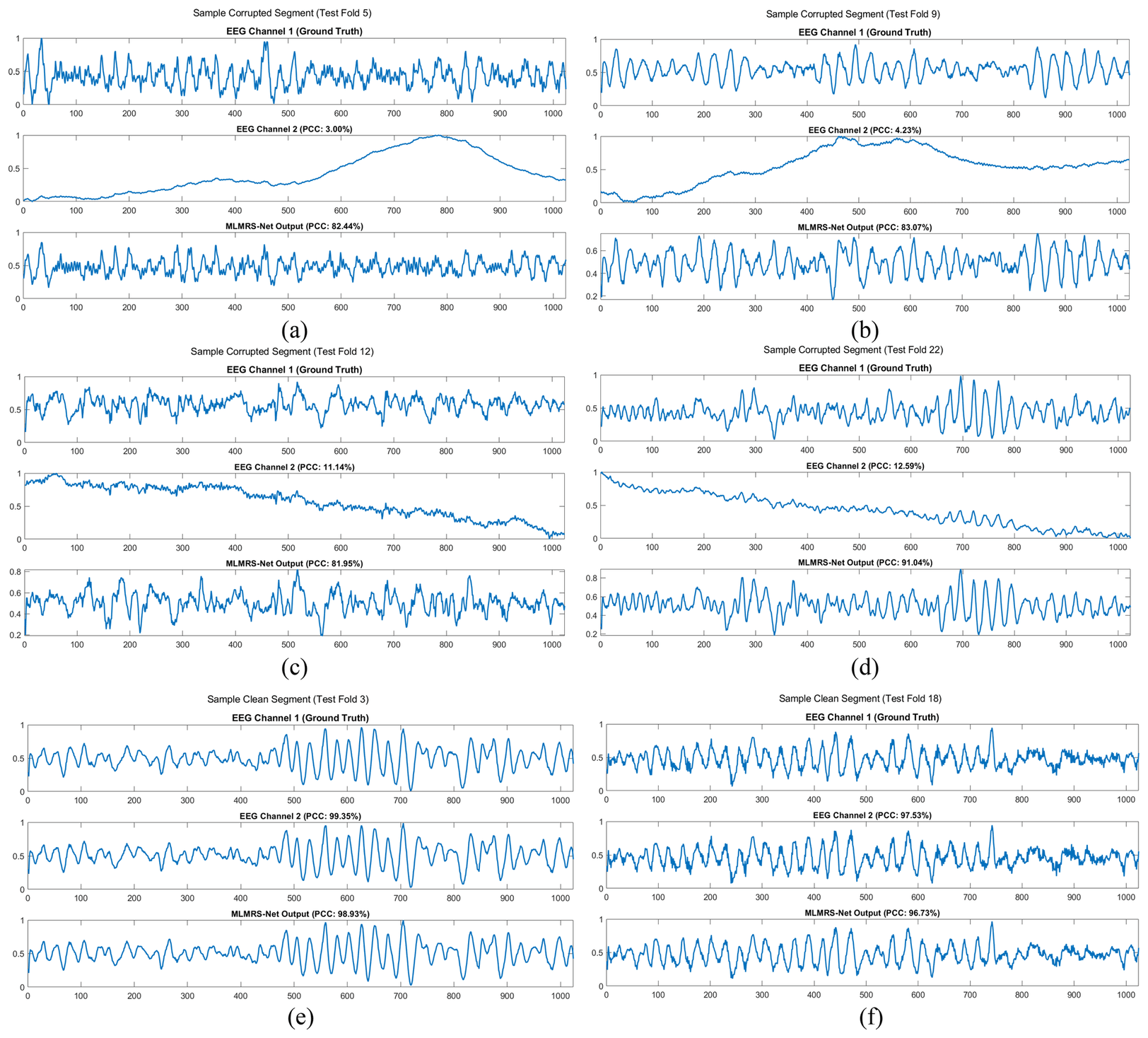
MLMRS-Net is a five-level, one-dimensional U-shaped network with multi-resolution pooling blocks in its encoder and decoder, and deep supervision at each decoder level. It was compared with 10 other 1D networks, testing each recording in turn on a model trained with the other 22. MLMRS-Net gave the highest artefact reduction and the lowest reconstruction error, while signal-to-noise gains were close across all networks.
EEG alone reached 89.32% artefact reduction. Adding three-axis accelerometer signals raised this to 90.52%, so strong restoration remained possible without extra motion sensors.
- Motion artefact reduction
- 90.52%
- Signal-to-noise improvement
- 26.64 dB
- Mean absolute error
- 0.056
| Signal-to-noise improvement | Artefact reduction | Mean absolute error | |
|---|---|---|---|
| FPN | 26.489 dB | 86.197% | 0.069 |
| U-Net | 26.568 dB | 88.817% | 0.064 |
| U-Net++ | 26.703 dB | 89.956% | 0.059 |
| Attention U-Net++ | 26.632 dB | 90.191% | 0.058 |
| MLMRS-Net | 26.641 dB | 90.516% | 0.056 |
Restoring EEG with an attention-guided operational CycleGAN
Engineering Applications of Artificial Intelligence · 2024
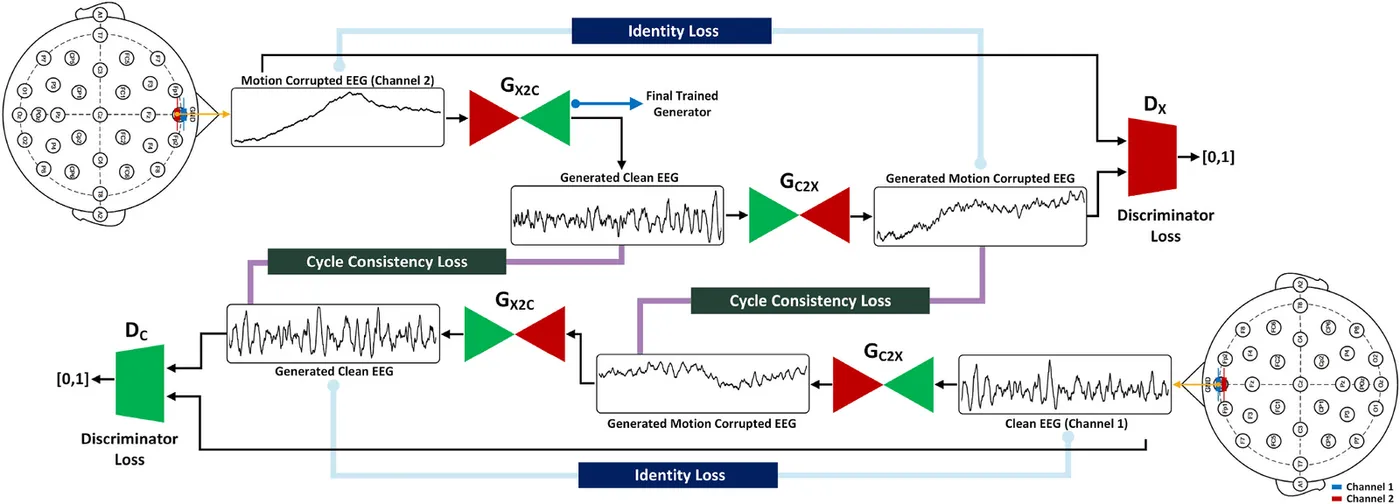
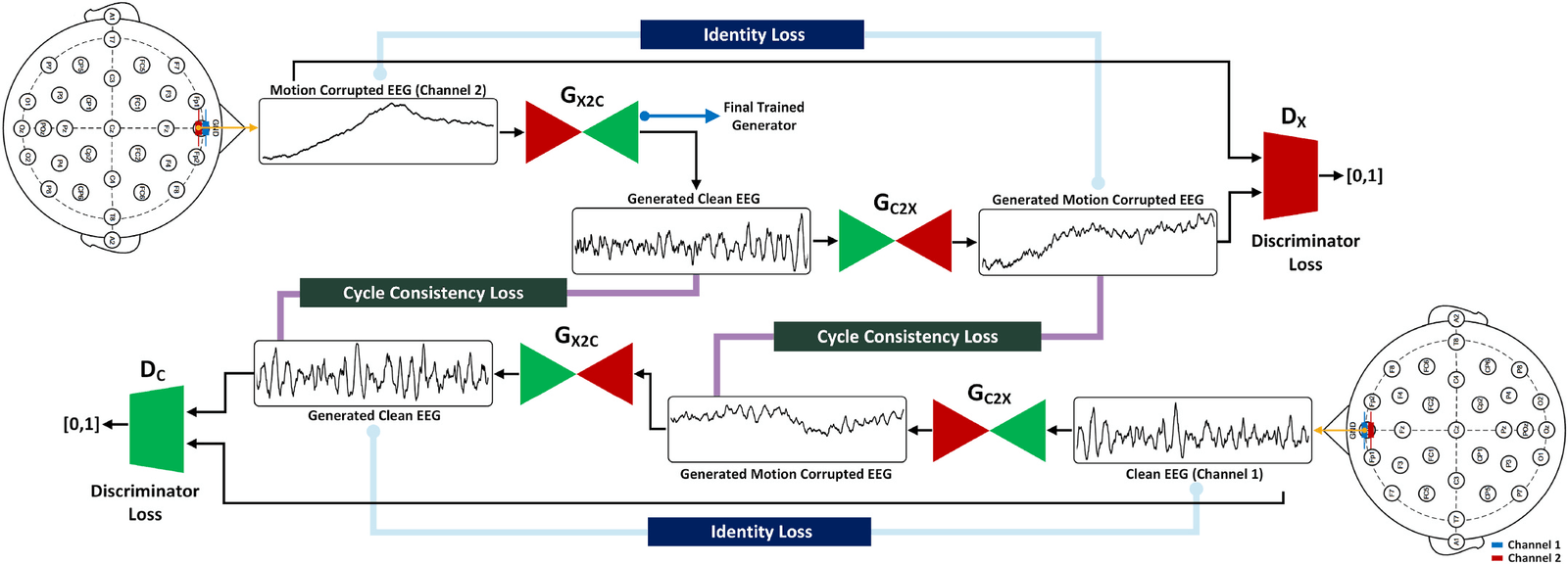
The second study used the same recordings and restored EEG directly from the corrupted channel. Baseline correction was applied to the reference channel, so the model learned to remove baseline drift together with motion artefacts.
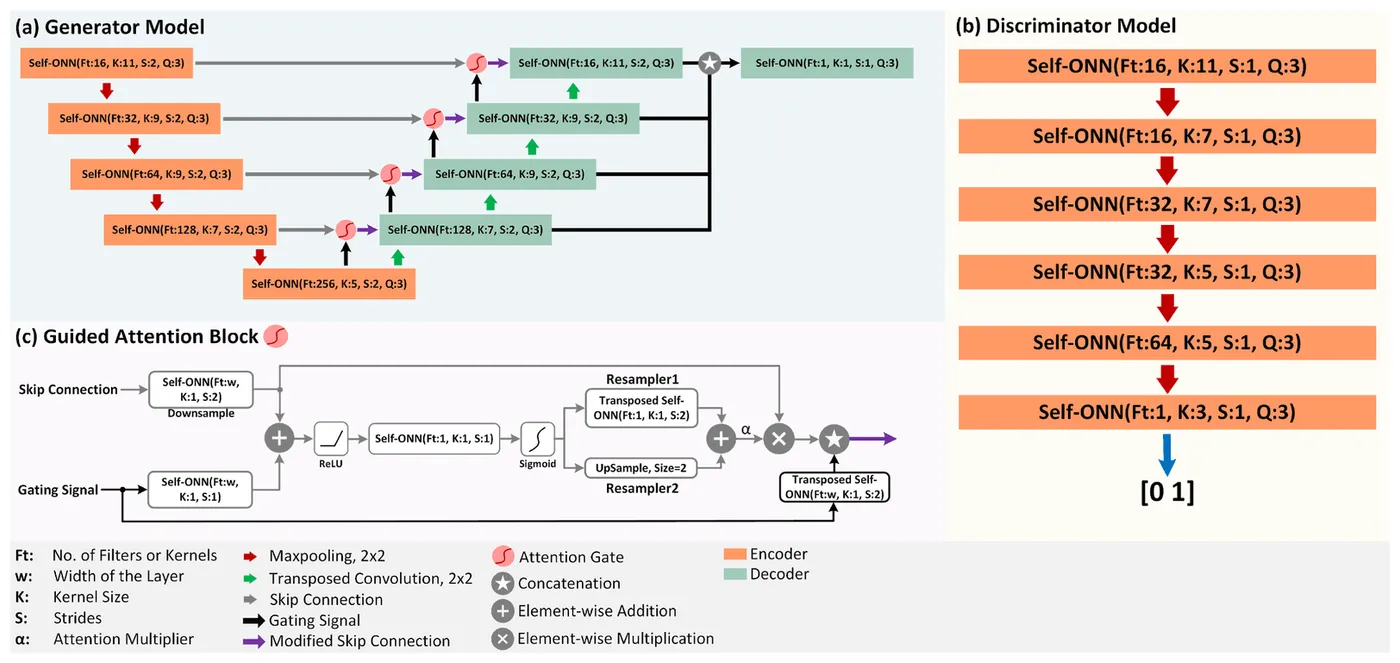
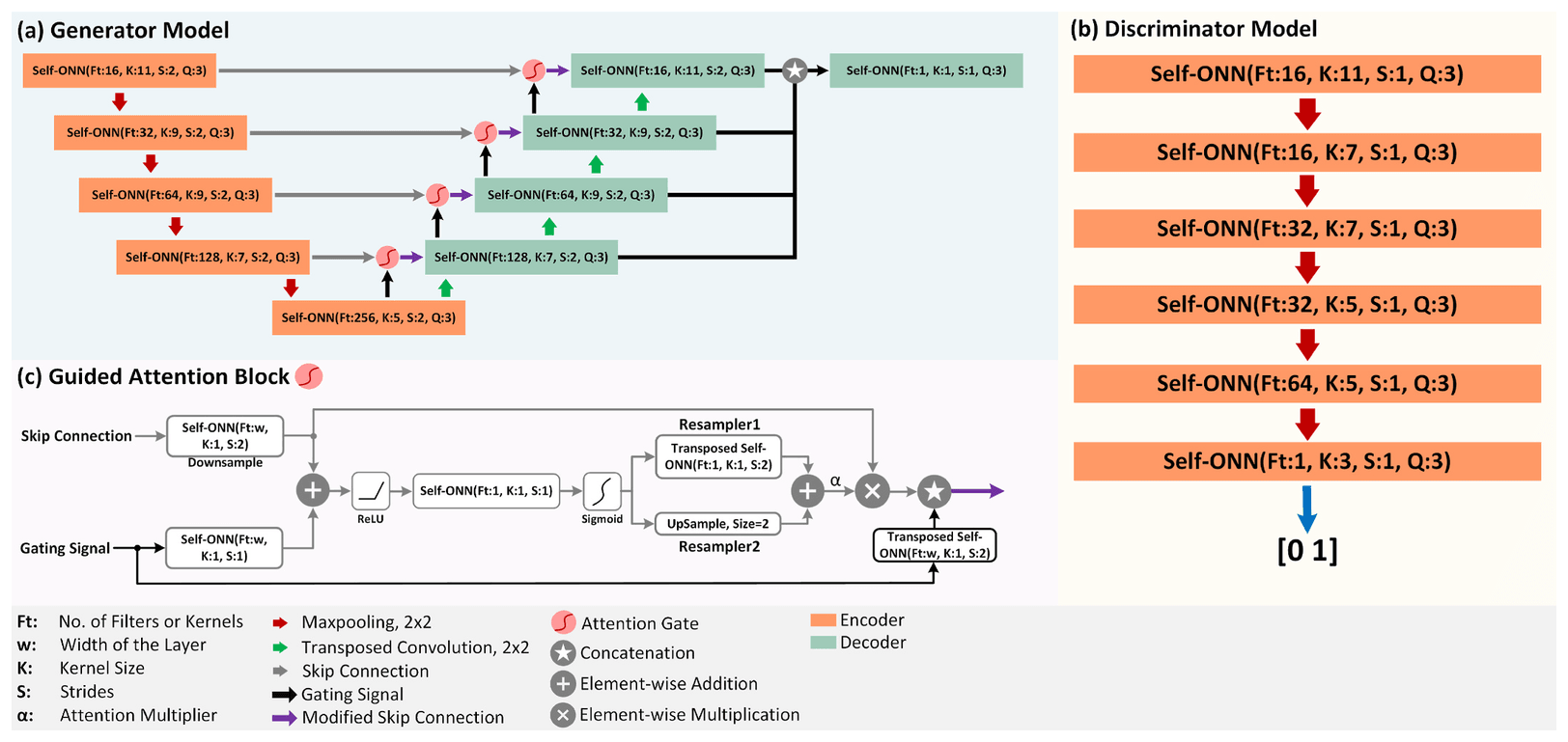
AGO-CycleGAN uses attention-guided Feature Pyramid Network generators and PatchGAN discriminators built with Self-ONN layers. Among six CycleGAN variants, this design gave the best temporal correlation, spectral correlation and signal-to-noise improvement. Only the restoration generator is needed after training, with 2.245 million parameters.
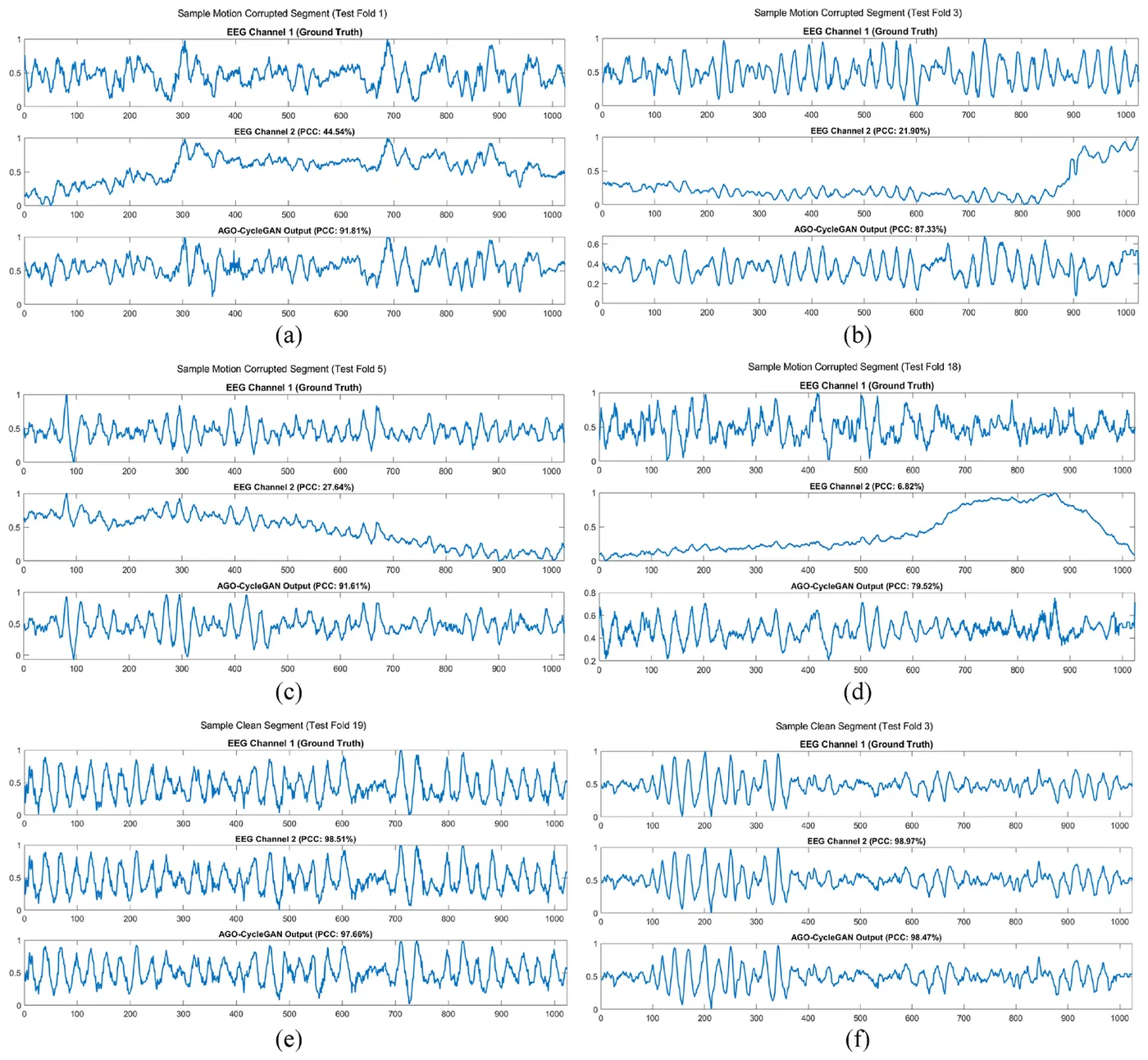
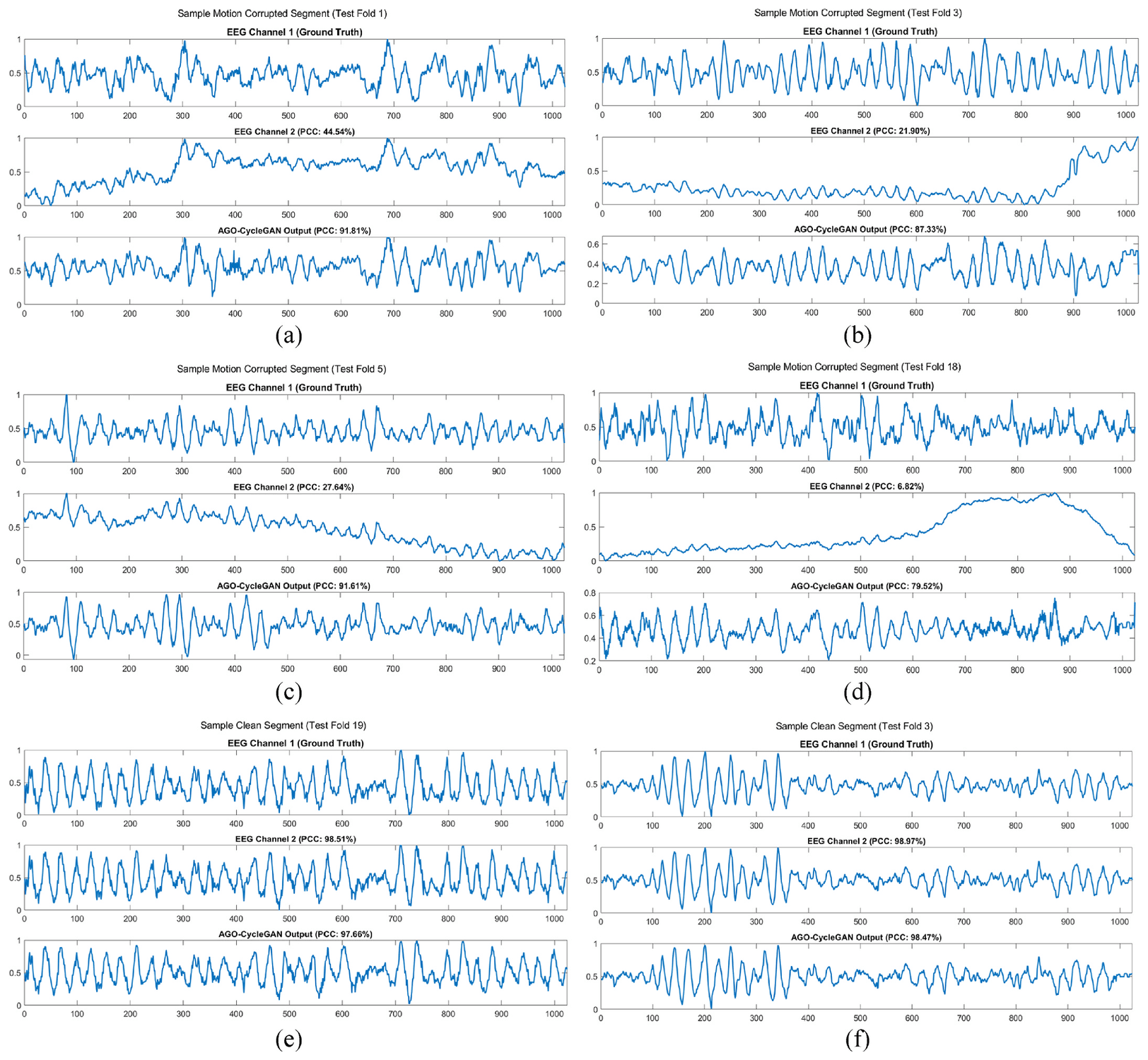
Motion-corrupted segments moved close to the reference after restoration, while clean segments stayed almost unchanged.
- Signal-to-noise improvement
- 26.50 dB
- Temporal correlation improvement
- 87.2%
- Mean absolute error
- 0.071
| Parameters | Temporal correlation | Spectral correlation | Signal-to-noise improvement | |
|---|---|---|---|---|
| CNN U-Net | 2.058 M | 0.848 | 0.918 | 25.619 dB |
| CNN FPN | 2.062 M | 0.857 | 0.921 | 25.210 dB |
| CNN attention FPN | 2.076 M | 0.869 | 0.933 | 26.328 dB |
| Self-ONN U-Net | 5.402 M | 0.865 | 0.926 | 25.873 dB |
| Self-ONN FPN | 5.408 M | 0.876 | 0.938 | 26.302 dB |
| AGO-CycleGAN | 5.540 M | 0.880 | 0.943 | 26.497 dB |
Recovering the EEG frequency profile
Engineering Applications of Artificial Intelligence · 2024
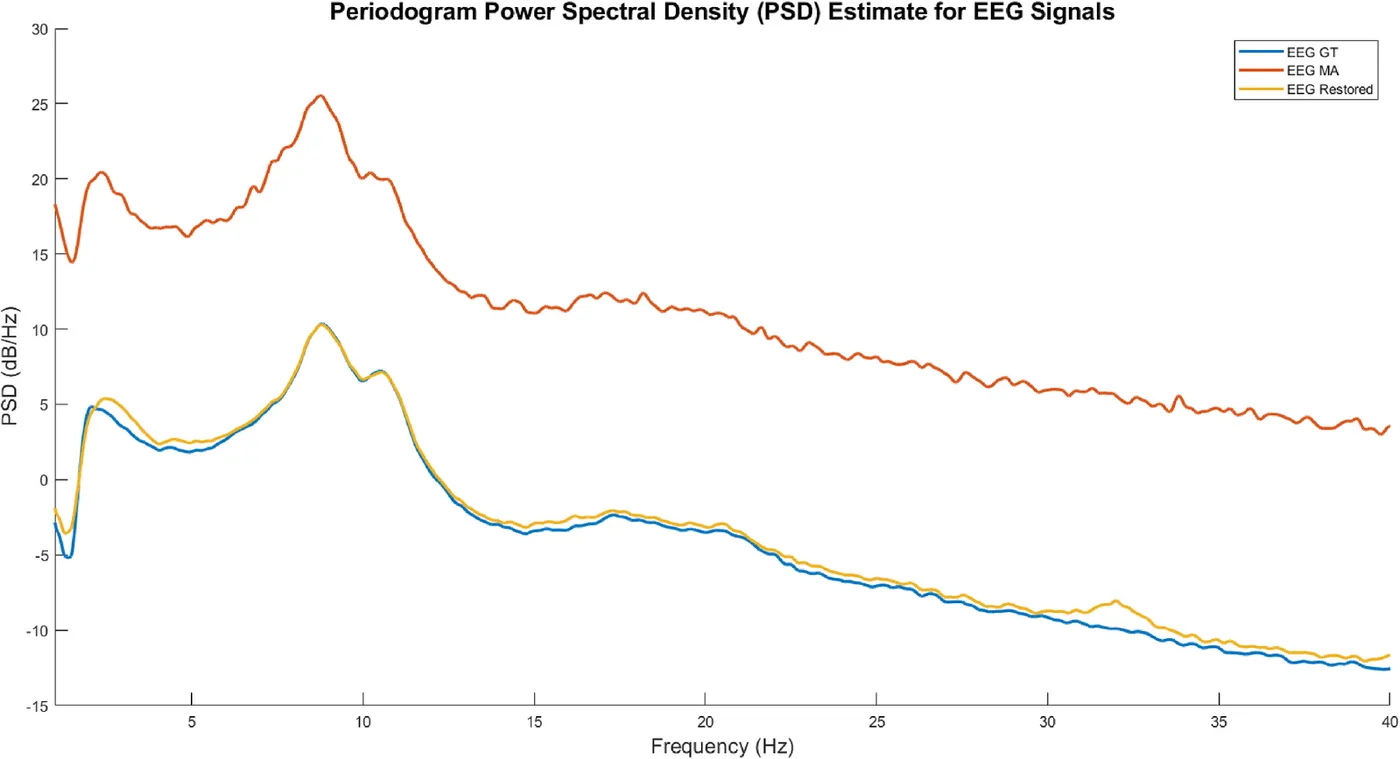
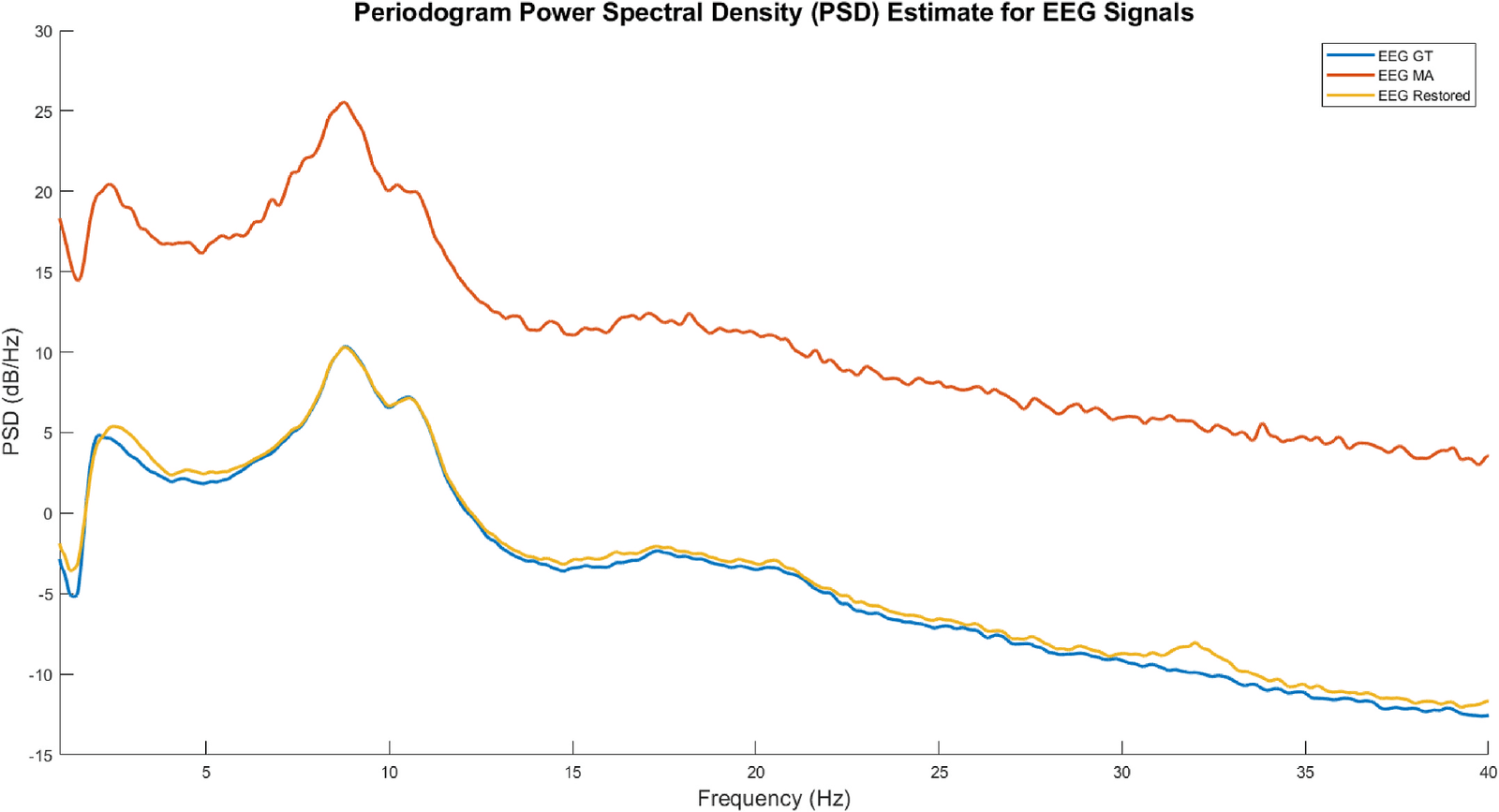
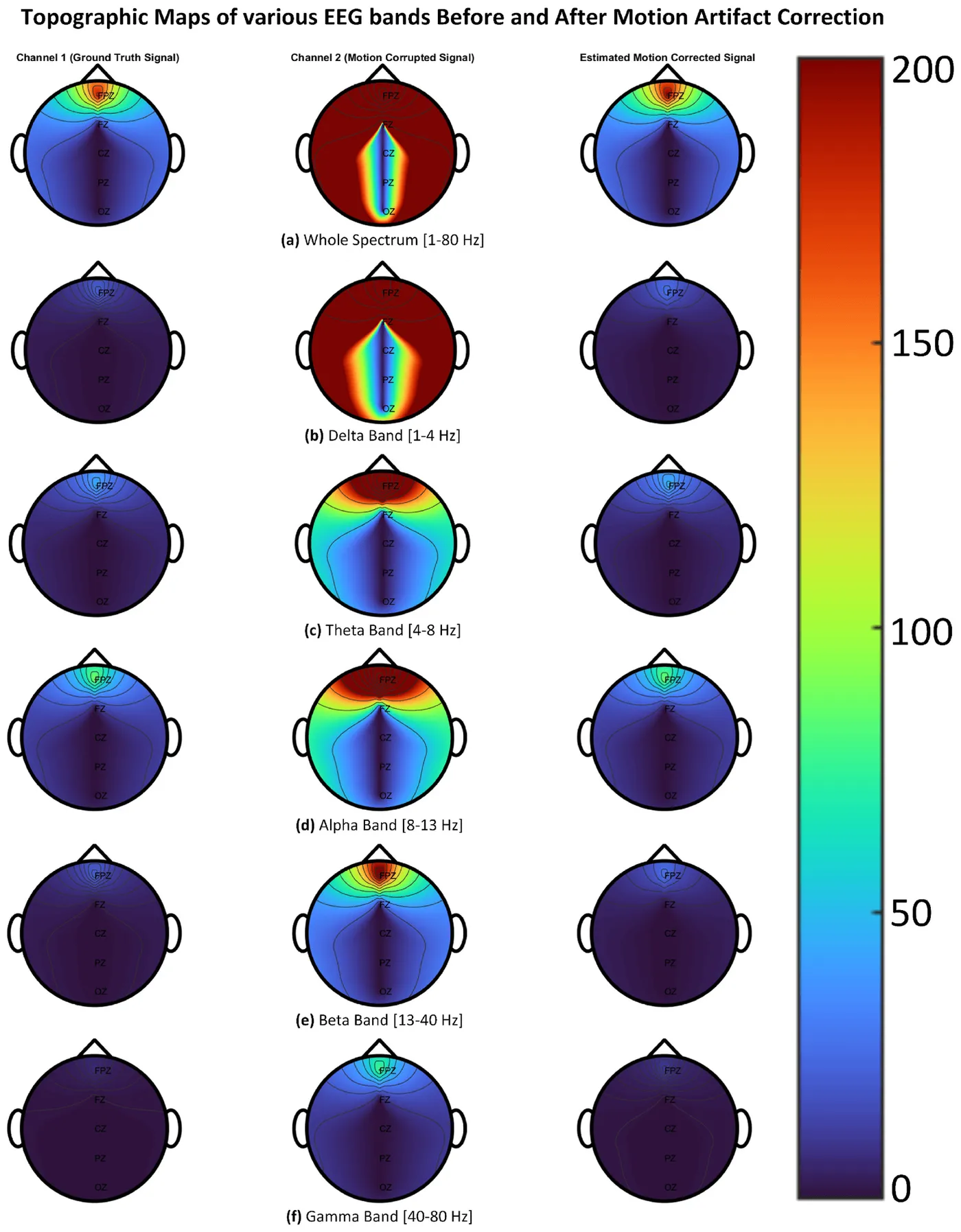
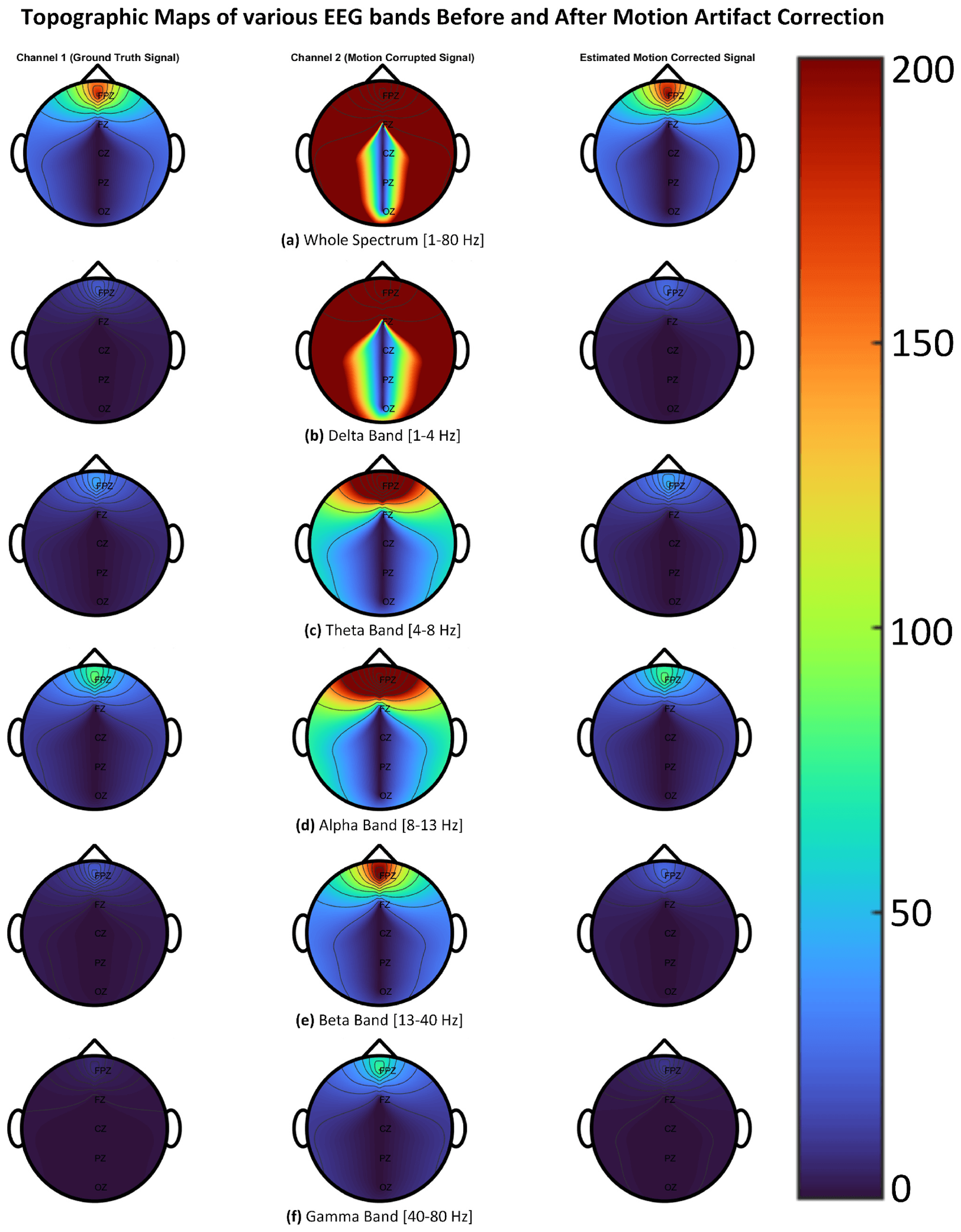
Motion artefacts added strong low-frequency power. The delta band rose from 10.7% to 60.1% of total EEG power, while the alpha band fell from 53.2% to 19.1%. After restoration, delta and alpha returned to 11.9% and 50.4%, close to the reference.
Spectral correlation with the reference increased from 0.128 to 0.943. Power spectra and topographic maps showed the same recovery across the EEG frequency bands.
- Spectral correlation improvement
- 93.5%
- Spectral correlation after restoration
- 0.943
- Restored delta power (reference 10.7%)
- 11.9%
| Delta | Theta | Alpha | Beta | Gamma | |
|---|---|---|---|---|---|
| Reference | 0.1070 | 0.2070 | 0.5317 | 0.1115 | 0.0430 |
| Motion-corrupted | 0.6011 | 0.1204 | 0.1913 | 0.0584 | 0.0290 |
| Restored | 0.1188 | 0.2059 | 0.5040 | 0.1172 | 0.0542 |
My contribution
I led the MLMRS-Net and AGO-CycleGAN studies, including model development, implementation, experiments, quantitative and qualitative analysis, and manuscript preparation. I also contributed to the studies in this project on eye and muscle artefact removal.
Study scope
Both studies used the same public dataset of 23 single-channel prefrontal recordings, with motion created by tapping one electrode and a nearby electrode providing the reference. Validation during natural movement, on multi-channel EEG and without a clean reference is still needed.
Publications
- Restoration of motion-corrupted EEG signals using attention-guided operational CycleGANEngineering Applications of Artificial Intelligence · 2024
- MLMRS-Net: Electroencephalography (EEG) motion artifacts removal using a multi-layer multi-resolution spatially pooled 1D signal reconstruction networkNeural Computing and Applications · 2023 (online 2022)
- MultiResUNet3+: A Full-Scale Connected Multi-Residual UNet Model to Denoise Electrooculogram and Electromyogram Artifacts from Corrupted Electroencephalogram SignalsBioengineering · 2023
- Deep Learning Technique to Denoise Electromyogram Artifacts from Single-Channel Electroencephalogram SignalsSignal, Image Processing and Embedded Systems Trends · 2022