Intelligent energy systems · 2024–2025
Edge AI and deep reinforcement learning for intelligent energy management
Occupancy sensing, privacy-preserving edge analytics and a broad review of deep reinforcement learning for energy systems.
E-Tawfeer project · Qatar University · Qatar National Research Fund NPRP14S-0401-210122 · Published studies and project development
Approach
How can AI support adaptive energy decisions while keeping sensitive building and household data protected?
E-Tawfeer is a research project on a secure, edge-based energy-efficiency platform that uses AI to support behavioural change. Useful energy decisions depend on knowing how buildings are used, yet detailed occupancy and appliance data can expose private routines. This work moved from compact occupancy sensing, to smart plugs and privacy-preserving analytics, to a wider review of how learning agents can optimise energy systems.
- Sense building use
- Analyse data near its source
- Optimise energy decisions
Compact occupancy detection from environmental sensors
Neural Computing and Applications · 2025
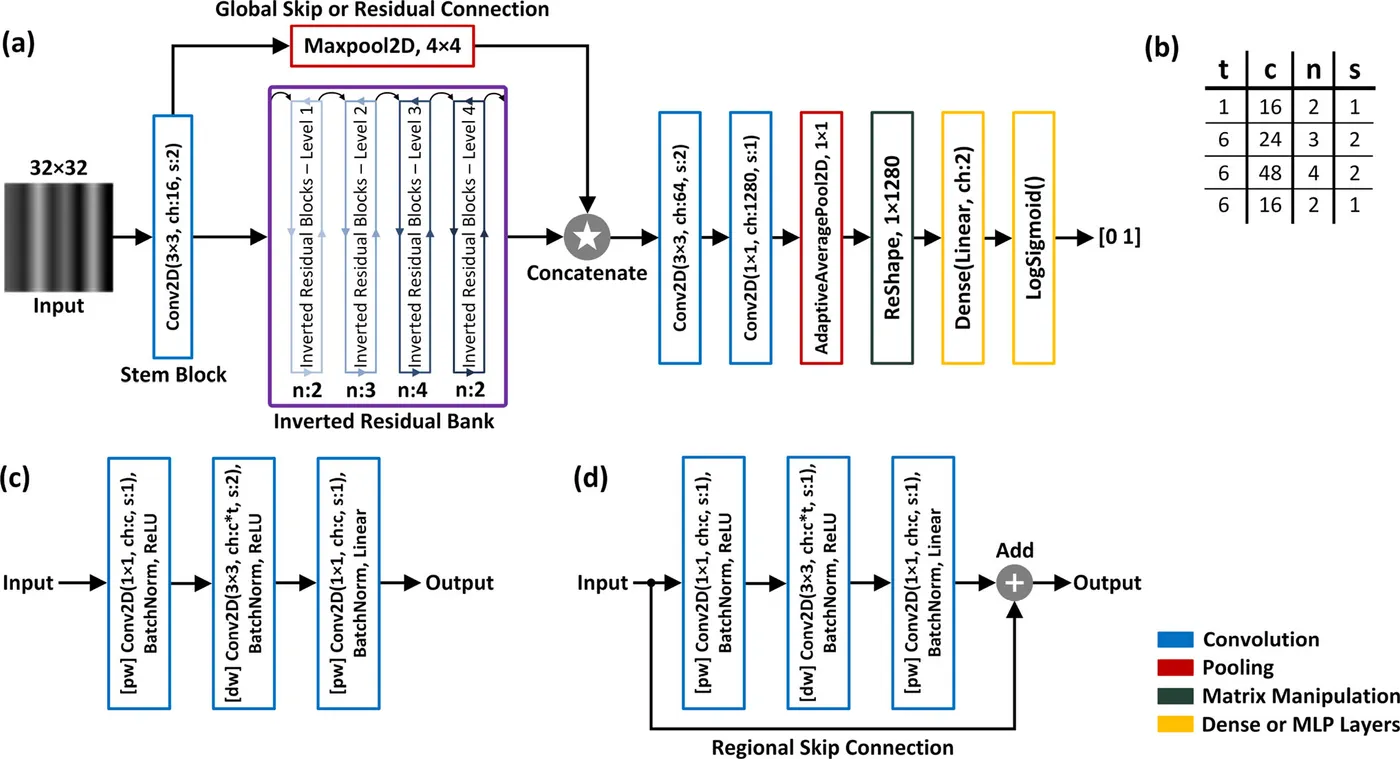
Knowing when a room is occupied helps buildings avoid wasted energy, but cameras and wearables raise cost, usability and privacy concerns. This study used environmental measurements such as temperature, humidity, light and carbon dioxide. Each short time window was converted into a small greyscale image for a convolutional network.
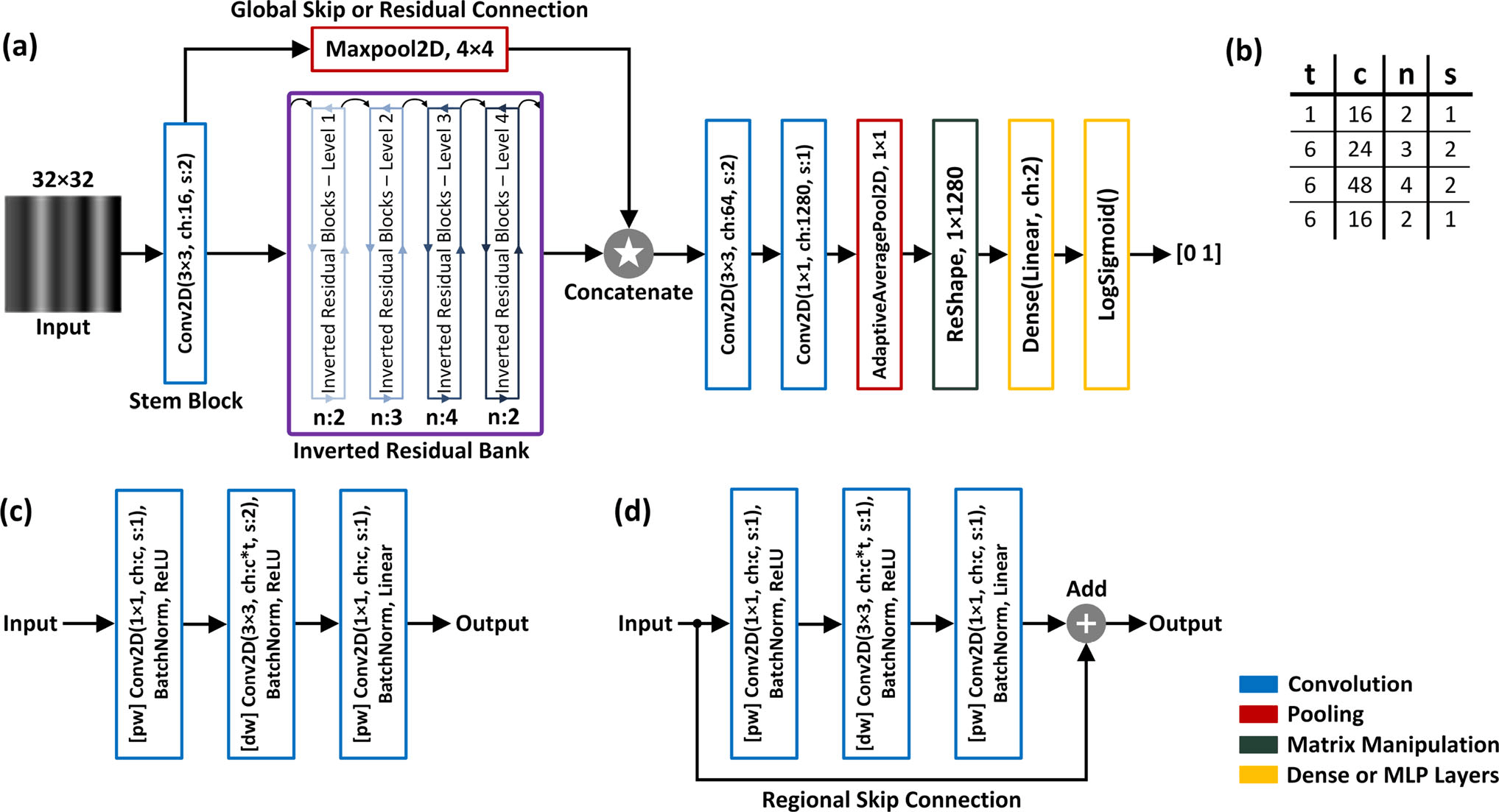
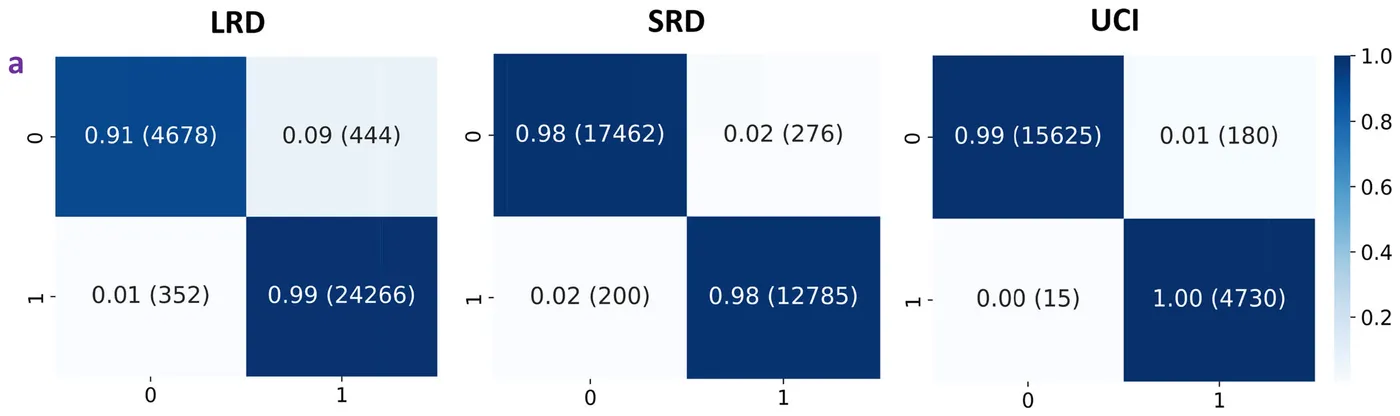
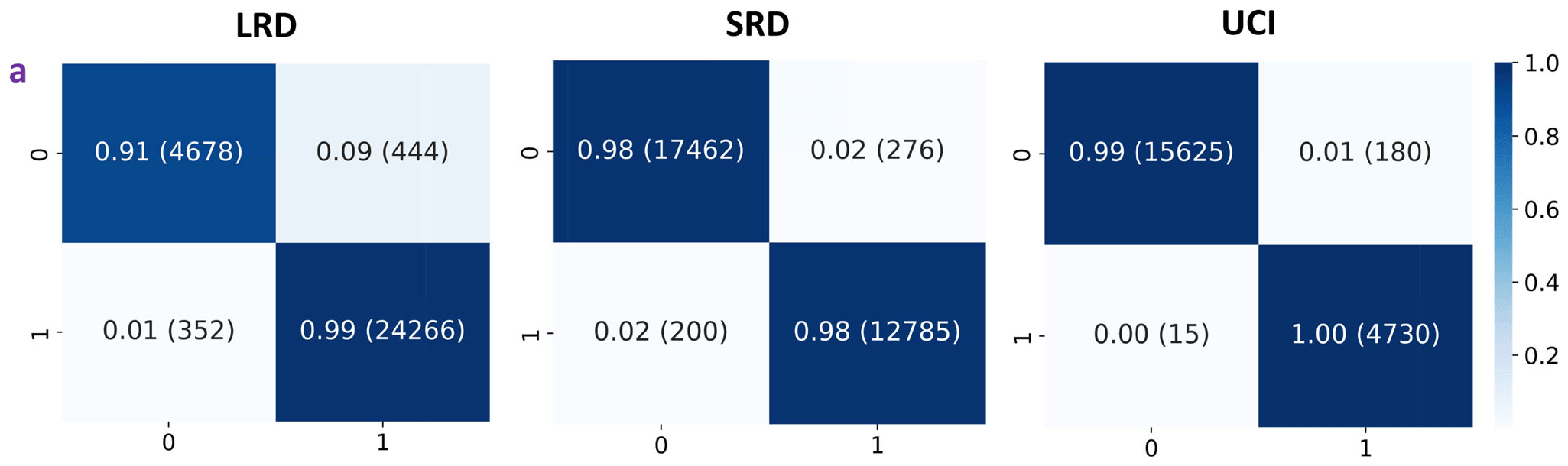
BOD-Net adapts MobileNetV2 inverted residual blocks and adds a global skip connection that joins early and late features. It was evaluated with fivefold cross-validation on three public datasets. Accuracy improved over the earlier image-based CNN on every dataset, with the largest gains on the student-room and living-room data.
The network has about 0.26 million parameters, compared with 2.2 million for MobileNetV2, and its reported inference time was 4.5 ms, compared with 129 ms. On the imbalanced living-room data, oversampling raised sensitivity from 92.58% to 96.88%, and XGBoost remained a strong alternative.
- Accuracy on UCI-ODD
- 99.05%
- Model parameters
- 262,866
- Reported inference time
- 4.5 ms
| Encoded samples | Earlier CNN | 1D-CNN | BOD-Net | |
|---|---|---|---|---|
| Student room (SRD) | 30,733 | 95.56% | 98.02% | 98.45% |
| Office room (UCI-ODD) | 20,560 | 99.00% | 98.91% | 99.05% |
| Living room (LRD) | 29,750 | 95.73% | 96.91% | 97.32% |
Smart plugs and privacy-preserving analytics
Project development · August 2024–June 2025
Appliance and occupancy data can reveal daily routines, so sending every measurement to a central server creates a privacy risk. The project therefore explored keeping more of the analysis close to where household data is produced.
I contributed to smart-plug design and development and to AI methods for residential energy management. I also implemented federated-learning concepts, in which devices train on local data and share model updates rather than raw measurements.
| Purpose | |
|---|---|
| Smart plugs | Bring energy sensing and control to individual appliances |
| Edge analytics | Process residential data close to its source |
| Federated learning | Learn across devices without pooling raw data |
Mapping deep reinforcement learning across the energy internet
Renewable and Sustainable Energy Reviews · 2026
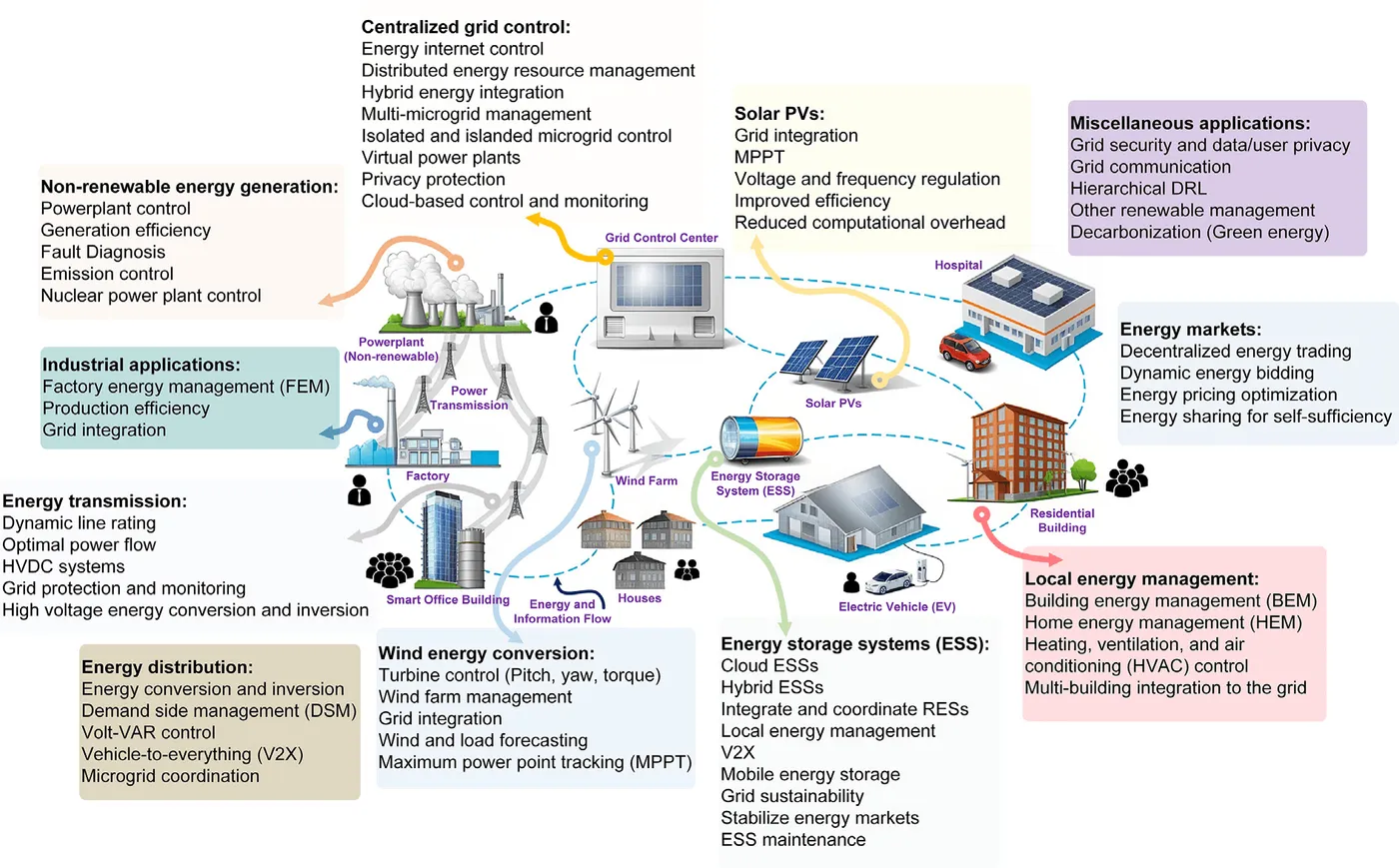
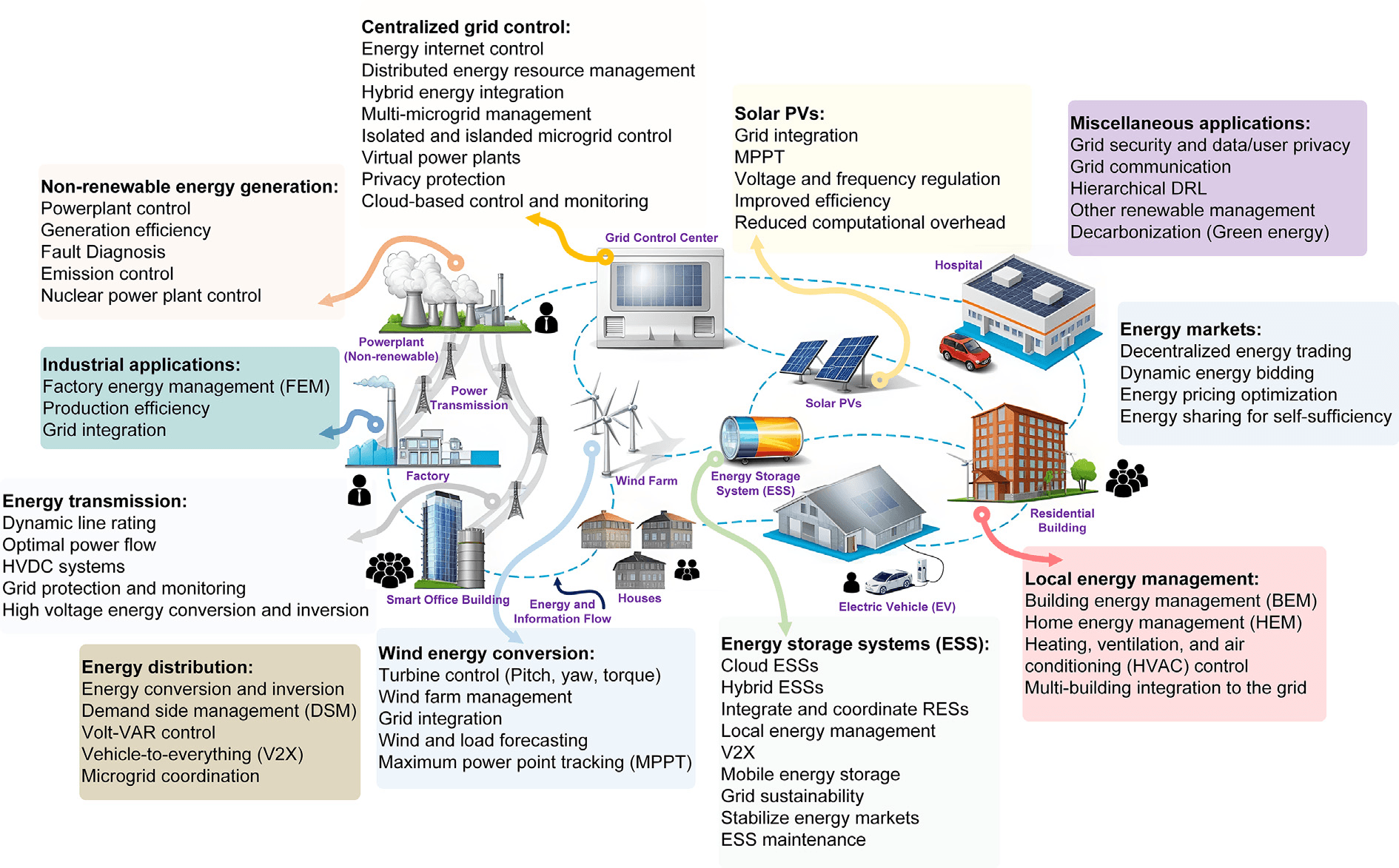
Modern energy systems must coordinate renewable generation, storage, flexible demand and markets under constant uncertainty. Deep reinforcement learning can learn sequential decisions in these settings, but earlier surveys usually focused on one part of the system. This review connects the full chain, from centralised generation to local energy management, security and privacy.
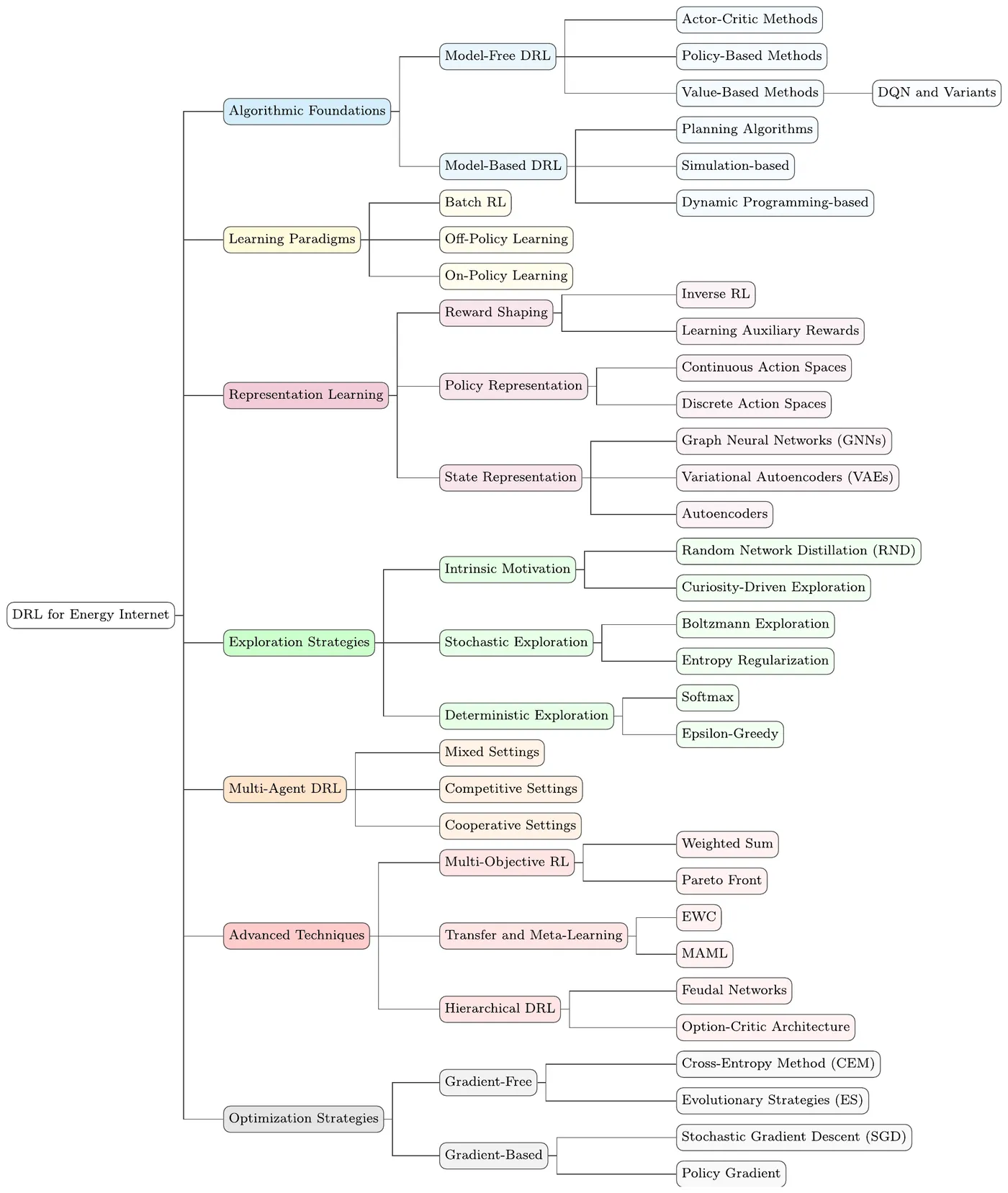
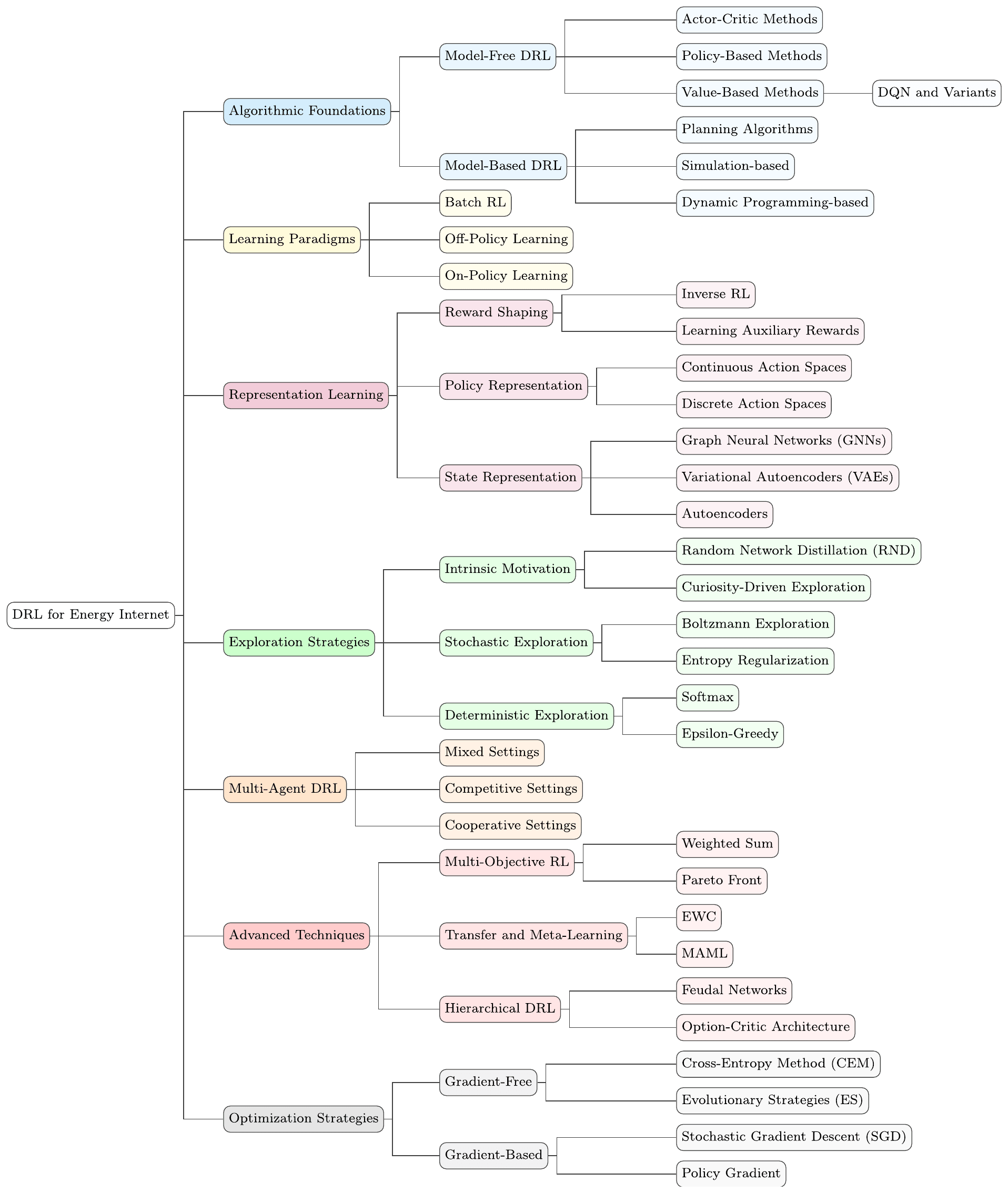
It organises methods by algorithmic foundations, learning paradigms, representation learning, exploration, multi-agent learning, advanced techniques and optimisation strategies, then links them to practical energy tasks. Reported gains include lower costs, reduced emissions and better operating efficiency, but they often depend on data quality, reward design and the chosen benchmark.
The main barriers are scarce or biased data, weak generalisation across assets and seasons, computational cost, safety constraints and the gap between simulation and field deployment. Promising directions include hierarchical and hybrid methods, graph-based multi-agent learning, transfer learning, and federated approaches that keep sensitive energy data local.
- Peer-reviewed studies synthesised
- 500+
- Publication window
- 2020–2026
- Energy application domains
- 8
| Decision problems | Example reported finding | |
|---|---|---|
| Generation | Solar and wind power tracking, turbine control, reservoir operation | A DQN framework increased annual hydropower production by 15% (Xu et al.) |
| Distributed resources | Hybrid scheduling, microgrid resources, virtual power plants | MATD3 bidding increased virtual power plant revenue by 65% (Jiang et al.) |
| Transmission | Dynamic line rating, optimal power flow, HVDC control | Emergency frequency control reduced generator tripping on a modified IEEE 39-bus system (Li et al.) |
| Distribution | Load management, voltage and frequency control, vehicle-to-everything, microgrids | Distributed load scheduling cut peak-to-average ratio by 12% and load variance by 11% (Chung et al.) |
| Energy storage | Hybrid storage, renewable integration, arbitrage, degradation | Grid-scale arbitrage achieved a 2.4-fold profit increase and 30% less on-peak grid use (Han et al.) |
| Energy markets | Trading, bidding, dynamic pricing, energy sharing | PPO-based dynamic pricing improved demand-response aggregator profit by 35% (Fraija et al.) |
| Local energy management | Building and home energy systems, storage, demand-side control | Online transfer learning achieved 20–40% cost savings in building energy control (Coraci et al.) |
| Security and privacy | Cyber-attack defence, resilient control, private data use | Adversarial learning strengthened inverter-based microgrids against cyberattacks on an IEEE 123-bus system (Wang et al.) |
My contribution
I redesigned the occupancy CNN and contributed to the experiments, analysis and manuscript. I contributed to smart-plug design and development and implemented federated-learning concepts. I led the reinforcement learning review, including its design, literature synthesis, taxonomy, comparative analysis, visualisations and manuscript drafting and revision.
Study scope
The occupancy results come from three public datasets, and wider testing across building types remains future work. The smart-plug and federated-learning work is presented as development activity, without performance claims. Findings in the review are those reported by the cited studies, and many depend on their simulation settings and benchmarks.
Publications
- A comprehensive review of deep reinforcement learning applications from centralized power generation to modern energy internet frameworksRenewable and Sustainable Energy Reviews · 2026
- Optimizing energy efficiency through precise occupancy detection: A tailored CNN architecture for smart buildings and beyondNeural Computing and Applications · 2025